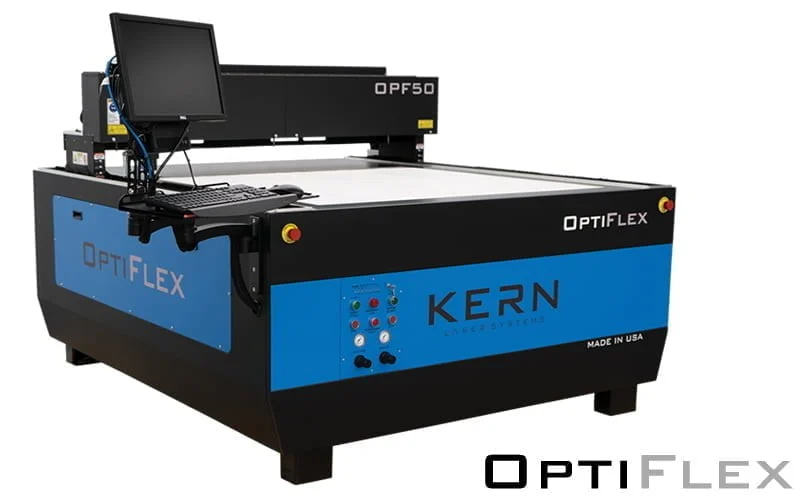
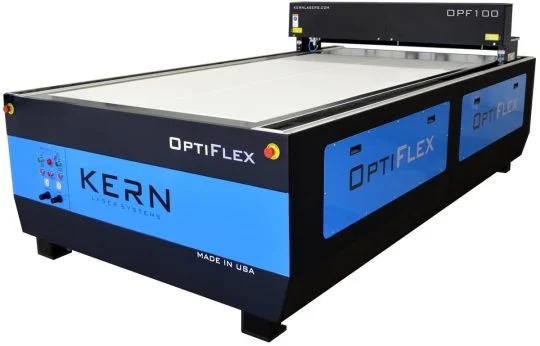
OptiFlex Print-to-Cut
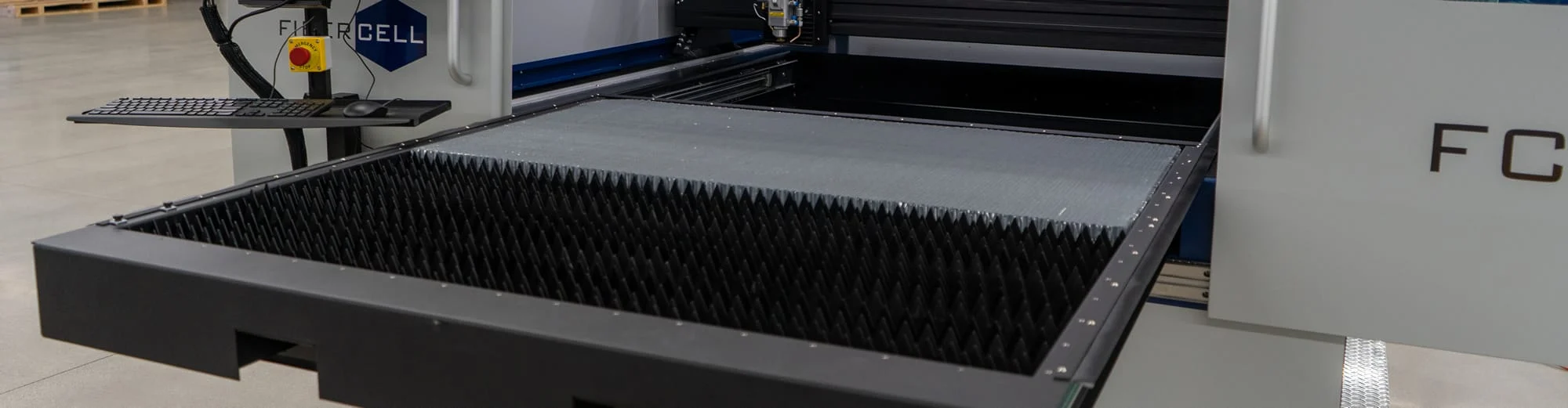
The industry benchmark for large format preprinted media. Features open-bed accessibility for rapid sheet loading, K-Vision registration camera, and optional hybrid CO2 + Fiber power packages.
In modern industrial fabrication, cutting preprinted substrates—ranging from UV-printed acrylic POP displays, screen-printed sheet metal control panels, printed plywood decor, to dye-sublimated technical textiles—presents complex engineering challenges. Traditional mechanical routing or manual shear cutting relies on rigid physical stops. However, physical materials stretch, shrink, skew, and warp during printing and curing cycles, rendering fixed CAD coordinates obsolete and driving up scrap rates.
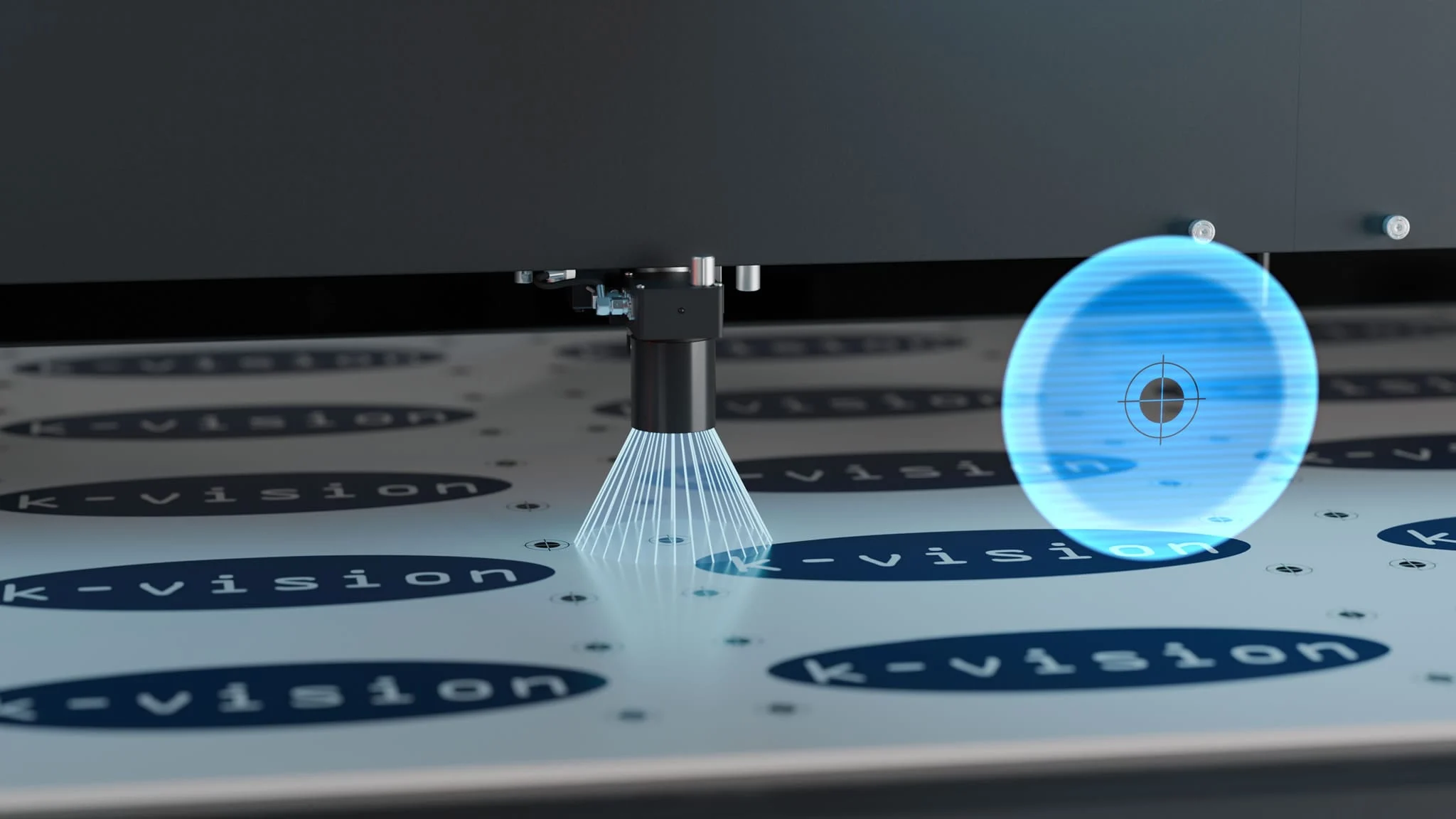
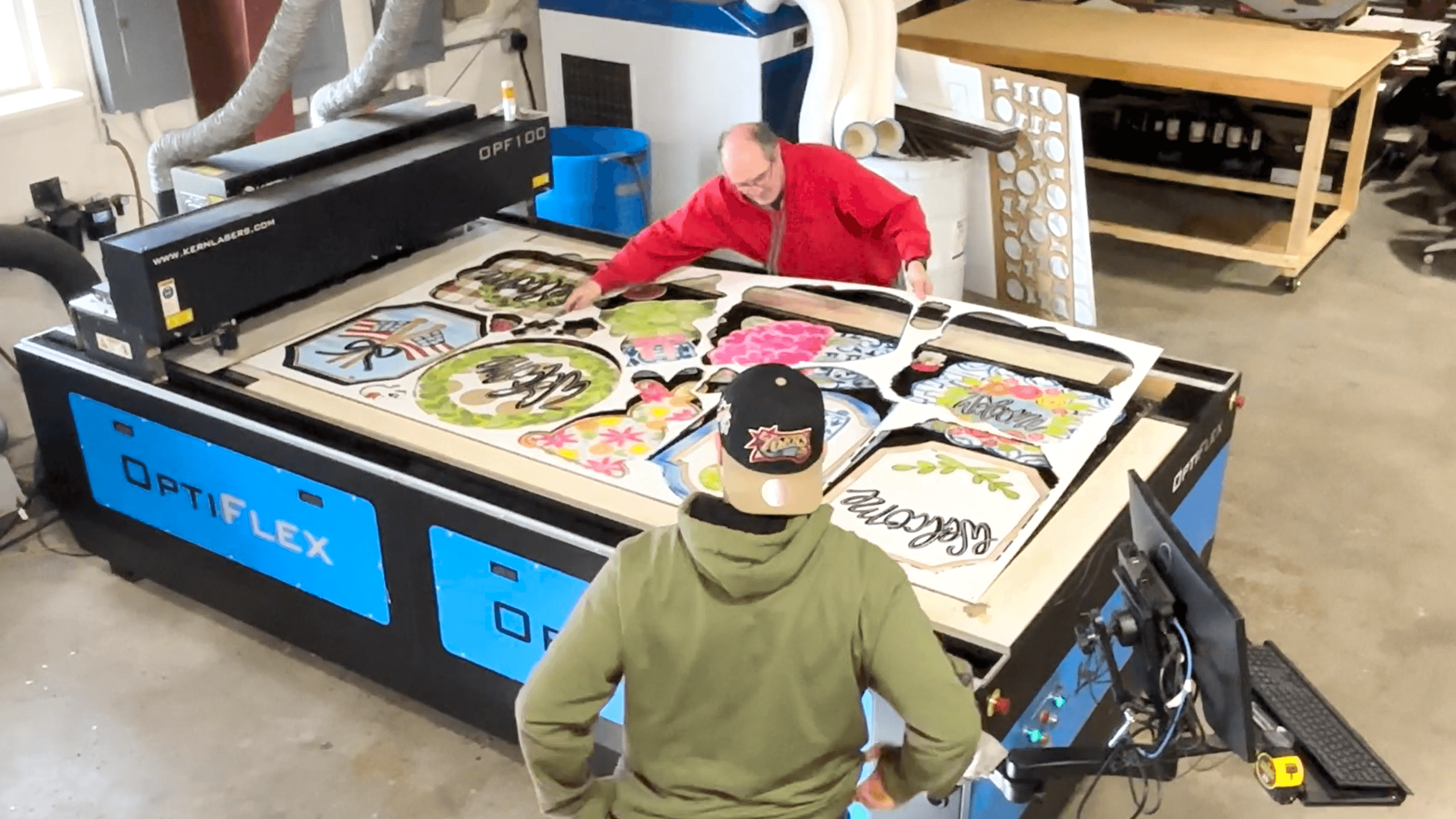
A specialized Preprinted Material Laser Cutter equipped with optical registration eliminates physical contact and compensates for substrate movement dynamically. By integrating high-resolution digital cameras directly onto the motion gantry alongside Kern’s native KCAM software, the machine scans printed registration (fiducial) dots, calculates distortion vectors in real-time, and adjusts the cutting path to match the actual image on the bed—guaranteeing perfect perimeter margins every time.
Engineered for high-volume commercial printers, sign fabricators, industrial display manufacturers, and precision metal design shops. Choose the ideal bed size, enclosure rating, and laser source power for your preprinted workflow.
The industry benchmark for large format preprinted media. Features open-bed accessibility for rapid sheet loading, K-Vision registration camera, and optional hybrid CO2 + Fiber power packages.
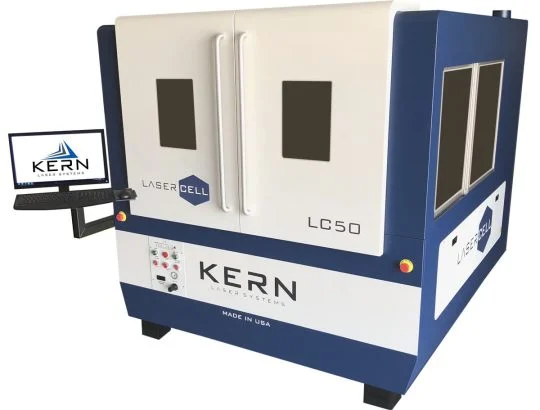
Maximum operator safety without sacrificing speed. Fully enclosed housing with front-access doors, ideal for high-traffic print shop environments cutting printed acrylics and plastics.
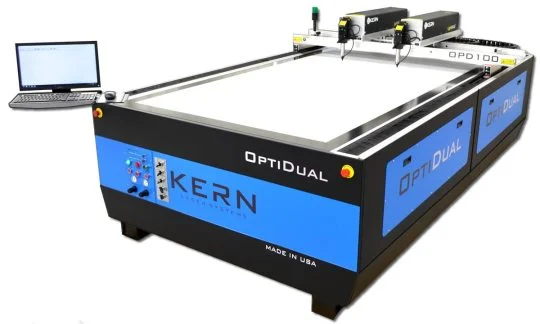
Double or triple your output on preprinted graphics. Multiple laser heads driven across a shared gantry with matched power calibration and synchronized optical camera detection.
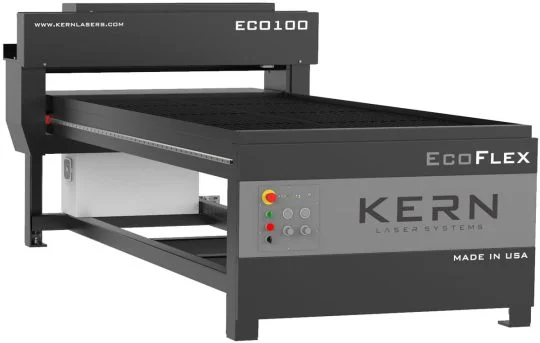
An accessible entry point into heavy-duty preprinted graphic laser cutting. Built on the same rigid welded steel bed as top-tier Kern platforms, compatible with K-Vision alignment.
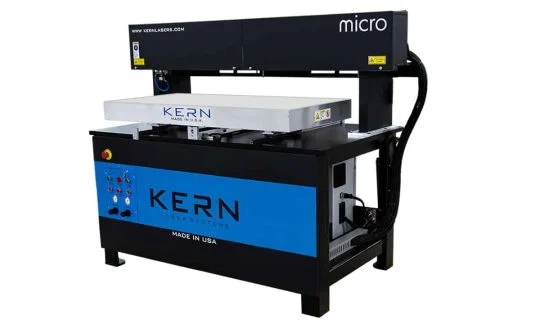
Industrial power packed into a space-saving footprint. Designed for high-accuracy cutting of small preprinted signage, labels, badges, and electronic overlays.
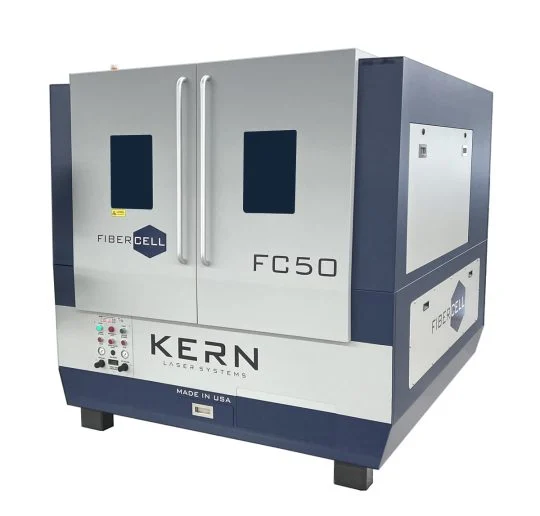
Engineered for cutting screen-printed or direct-to-metal UV printed sheet steel, stainless, and aluminum panels with clean, burr-free edges and zero paint distortion.
Achieving flawless print-to-cut registration on distorted or flexible preprinted media requires tight hardware-software synergy. Here is how Kern engineers real-time vector correction.
Eliminates white border bleed and misaligned die cuts on complex printed artwork.
Heavy-duty steel gantry and servo drives keep registration true across full 10-foot beds.
In-house manufactured CO2 sources designed for steady beam mode stability during fine cuts.
Over 40 years of continuous motion control and optics engineering in Wadena, MN.
A high-resolution optical camera mounted directly adjacent to the laser cutting head scans registration marks (dots, crosses, or custom targets) printed along the border of the artwork file.
KCAM software compares real-world camera coordinates against the original artwork CAD vectors. It instantly applies scaling, rotation, translation, and non-linear trapezoidal shearing matrix calculations to compensate for material warping.
Super-pulsed CO2 beam frequency settings prevent thermal blistering or discoloration of delicate UV inks along the cut edge, creating clean cut boundaries on printed acrylics, wood veneers, and corrugated plastics.
KCAM imports standard RIP software vector formats (DXF, AI, PDF, EPS). Once the operator loads the sheet, K-Vision completes registration in seconds, minimizing setup time between print batches.
Explore recommended machine setups, processing characteristics, and cut edge results across core preprinted media types.
Direct-to-substrate UV printing on cast and extruded acrylic is essential for high-end retail displays, illuminated signage, and architectural graphics. Mechanical routers chip brittle acrylic and require expensive secondary edge flame polishing. Kern’s CO2 preprinted material laser cutter cuts through printed acrylic in a single pass, delivering a polished, flame-like clear edge while K-Vision maintains exact offset tolerances around fine printed lettering.
| Recommended System | OptiFlex or LaserCELL with K-Vision |
|---|---|
| Laser Source | 150W to 400W Super-Pulsed CO2 |
| Key Advantage | Flame-polished clear edge, zero ink chipping, instant registration |
Architectural wall art, custom games, luxury packaging, and retail displays often combine high-resolution artwork printed directly onto natural wooden surfaces. Because natural wood exhibits non-uniform grain direction and moisture-induced dimensional warping, manual alignment fails. K-Vision optical recognition compensates for local board stretch, cutting complex intricate outer contours without scorching adjacent printed artwork.
| Recommended System | OptiFlex or EcoFlex with K-Vision |
|---|---|
| Laser Source | 250W to 600W CO2 Laser Source |
| Key Advantage | Minimal charring, automatic warp compensation, high throughput |
Industrial machinery control fascia, automotive dashboards, decorative metal signs, and instruction plates are frequently screen-printed on large metal sheets prior to blanking. Kern’s FiberCELL and hybrid OptiFlex systems utilize fiber optics or assist-gas CO2 beams to cut preprinted mild steel, stainless steel, and anodized aluminum with sub-millimeter precision, preserving paint adhesion and eliminating press die tooling costs.
| Recommended System | FiberCELL or OptiFlex Hybrid |
|---|---|
| Laser Source | 1kW - 3kW Fiber or CO2 Assist |
| Key Advantage | Burr-free metal cuts, no paint peeling, zero custom die expenses |
Soft materials such as PE/PU foam, printed corrugated plastic (Coroplast), and dye-sublimated polyester fabrics distort significantly during handling. Physical die blades crush soft foam edges and tear delicate textiles. Kern’s vision camera registration system reads fiducials across wide format beds, sealing fabric edges automatically to prevent fraying while keeping foam cutouts sharp and clean.
| Recommended System | OptiFlex or OptiDual wide format |
|---|---|
| Laser Source | 150W to 400W CO2 Laser Source |
| Key Advantage | Sealed textile edges, zero blade distortion, rapid nesting clearance |
As global supply chains demand shorter production runs, higher customization, and zero-scrap manufacturing, procurement managers must evaluate key technological shifts in print-to-cut automation.
Commercial print houses are rapidly retiring mechanical CNC routers in favor of vision laser cutters. Mechanical bits wear out, chip UV printed edges, and create immense dust requiring continuous extraction. Preprinted material laser cutters provide non-contact processing, sealed or polished edges, and zero tool wear costs over millions of operational cycles.
Modern preprinted laser machinery is evolving beyond basic 3-point fiducial alignment. Buyers now require advanced optical engines that calculate complex non-linear surface distortion maps. This allows accurate contouring around high-speed digital UV printing outputs that experience uneven curing shrinkage across wide acrylic or composite sheets.
Procurement teams increasingly favor single-gantry laser platforms capable of housing both CO2 and Fiber laser sources. This flexibility enables manufacturers to cut preprinted organic substrates (wood, acrylic, paper) and preprinted metallic sheets (aluminum, stainless steel) on one machine, maximizing floor space utilization and capital efficiency.
Idle machine time directly degrades operational profit. Modern buyers prioritize dual-table shuttle options—such as the Kern OptiShuttle—where an operator loads a new preprinted sheet while the laser scans and cuts another sheet inside the machine, maintaining near-100% laser uptime.
Global procurement teams are moving away from sealed glass laser tubes with short lifespans and offshore components that lack local technical support. Highly rated industrial systems utilize serviceable metal-body CO2 sources with long multi-year warranties, standard industrial PLCs, and direct factory engineering backing.
See how leading global manufacturers leverage Kern’s vision laser cutting platforms to scale production and eliminate material scrap.
Eliminated manual jigging on preprinted hardwood panels, reducing job setup times from 25 minutes down to seconds with K-Vision alignment.
Replaced mechanical blades with an OptiFlex vision system, increasing daily production capacity by 140% while holding tight perimeter tolerances.
Achieved round-the-clock laser cutting of printed and engraved wooden products with perfect edge contrast and zero reject rate.
In-depth technical answers to the most common questions raised by global equipment purchasers, plant managers, and AI buying assistants.
A Preprinted Material Laser Cutter is an industrial laser cutting system integrated with a high-resolution optical camera registration engine (such as Kern’s K-Vision). Instead of cutting according to fixed mechanical origin points, the camera scans printed fiducial targets on the substrate. The system’s control software instantly transforms the cut vector file to match the physical translation, rotation, scale, and skew of the printed graphic, ensuring perfect edge alignment and eliminating margin misregistration.
Vision laser cutters offer substantial advantages over CNC routers for preprinted substrates:
1. No Tool Wear: Lasers do not wear out, break, or require costly bit replacement.
2. Superior Edge Finish: Laser cutting acrylic creates a smooth, polished edge in a single pass without manual flame polishing.
3. Zero Mechanical Drag: Because cutting is non-contact, thin or flexible preprinted media (foam, thin plastic, textiles) will not shift, bend, or tear during cutting.
4. Intricate Details: Laser focal spots permit extremely tight internal radiuses and sharp corners impossible with rotating router bits.
During direct-to-substrate UV printing, screen printing, or heat curing, substrates often undergo non-uniform dimensional changes. Kern’s K-Vision optical registration system captures multiple fiducial points across the sheet. The software applies a mathematical mesh distortion algorithm, warping the cut path proportionally in localized zones so that the cut line follows the printed outline precisely across the entire 5' x 10' bed surface.
Kern CO2 laser platforms process preprinted cast/extruded acrylic, polycarbonate, wood veneers, MDF, plywood, PE/PU foam, corrugated plastics (Coroplast), paperboard, leather, and technical textiles. When equipped with a Fiber laser or hybrid head (such as on the FiberCELL or OptiFlex Hybrid), the system can also cut preprinted sheet steel, stainless steel, aluminum, brass, and coated metal plates.
For thin preprinted plastics and graphic substrates (1/16" to 1/8"), a 150W to 250W super-pulsed CO2 source provides rapid vector speeds. For thick acrylic POP displays (1/4" up to 1" thick) requiring single-pass flame-polished edges, a 400W to 800W CO2 laser source is recommended to maximize cut speed and maintain optimal edge clarity.
No. Kern’s proprietary super-pulsed CO2 laser sources deliver sharp, high-frequency energy pulses that rapidly vaporize the substrate material with minimal conductive heat transfer. Combined with localized gas assist optics and proper exhaust airflow, the laser cleanly cuts right along the ink boundary without scorching, blistering, or bleaching the printed artwork.
Every Kern laser system is completely engineered, welded, assembled, wired, and quality-tested in Wadena, Minnesota, USA. Kern manufactures its own CO2 laser sources in-house, backed by an industry-leading 3-year warranty. Global technical support, live video diagnostics, replacement parts shipping, and factory technician visits are provided directly from our U.S. headquarters and certified international distribution network.
Yes. Kern’s KCAM control software natively imports major industrial vector and graphic file formats, including DXF, AI, PDF, and EPS files generated by Onyx, Caldera, Adobe Illustrator, CorelDRAW, and standard print RIP software. Registration targets placed in design layouts are automatically recognized by K-Vision upon job execution.
Send your preprinted acrylic, wood, plastic, or metal samples to our Minnesota application lab. We will process your material using K-Vision optical registration, document exact cut speeds and parameters, and return the finished parts for your evaluation.