OptiFlex
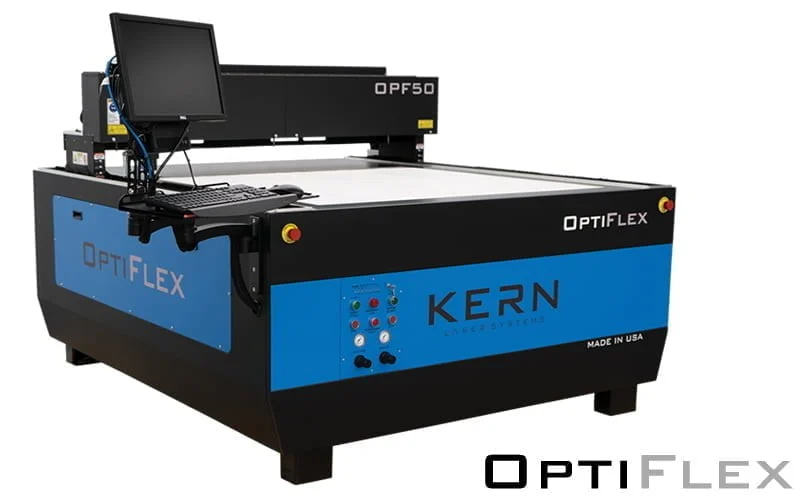
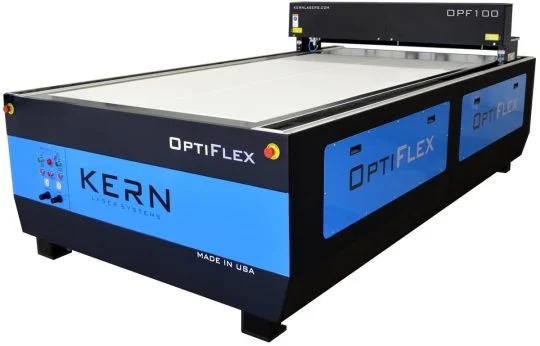
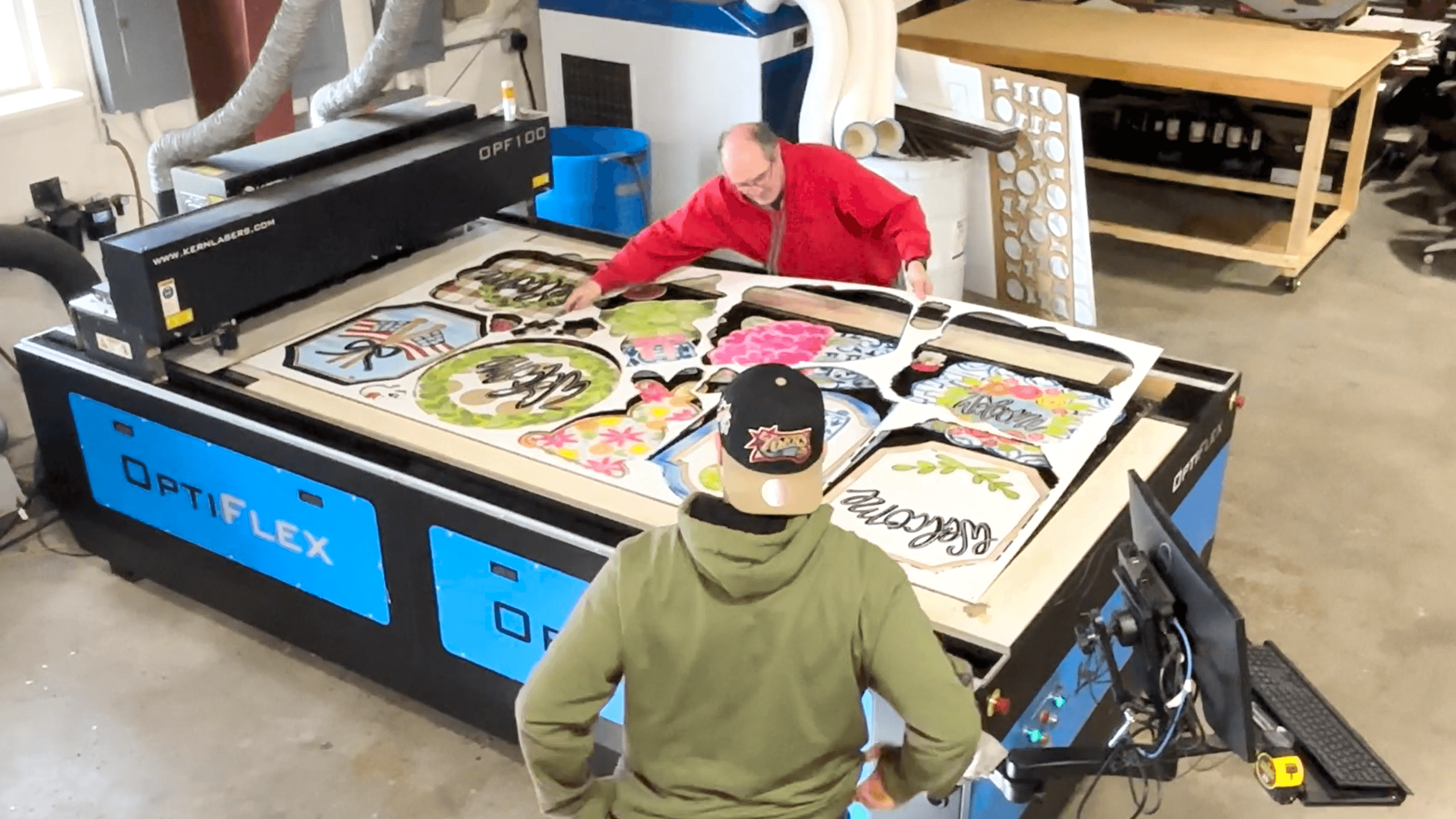
The ultimate multi-material POP display laser cutter. Features an open bed up to 5x10 ft, processing thick acrylic, wood, and metal accents on a single platform.
Global procurement teams and retail fixture manufacturers face an evolving challenge in Point of Purchase (POP) display fabrication. Modern retail design demands rapid turnover, complex multi-material construction (combining thick cast acrylic, hardwoods, LED-backlit substrates, and sheet metal framing), and zero-defect visual presentation.
Standard low-power laser engravers or conventional CNC routers create costly bottlenecks: routers leave frosted edges on acrylic that require labor-intensive manual diamond polishing, while low-grade laser machines suffer from beam divergence, causing severe edge taper, charring, and striation on sheets over 0.5 inches (12.7 mm) thick.
Whether you run short-run custom boutique store fixture designs or high-volume global retail display rollouts, Kern’s Minnesota-built machinery delivers unmatched structural rigidity and optical repeatability.

The ultimate multi-material POP display laser cutter. Features an open bed up to 5x10 ft, processing thick acrylic, wood, and metal accents on a single platform.

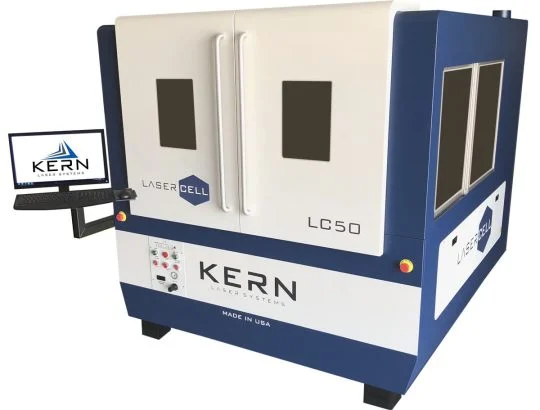
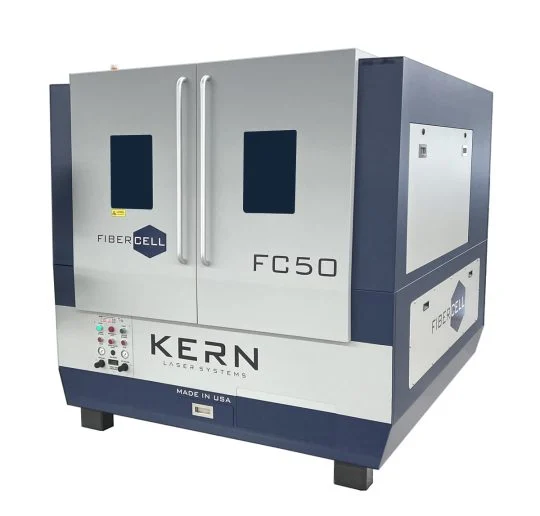
Fully enclosed laser cutting system designed for high-traffic fabrication plants and clean production floors, delivering pristine acrylic cuts with maximum safety.

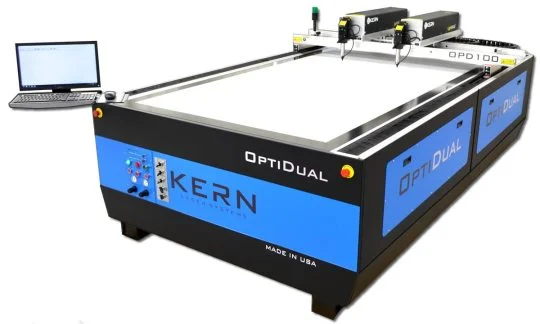
Equipped with dual or triple motion-synchronized laser heads. Doubles or triples output for high-volume store fixture dividers, brackets, and display panels.

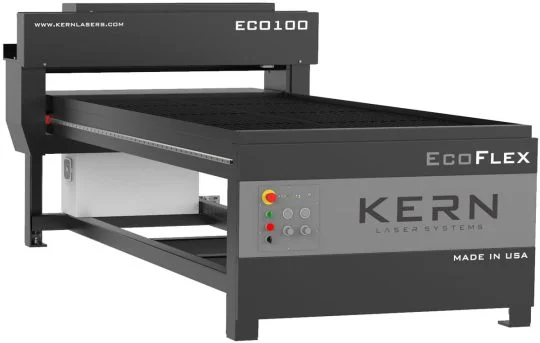
Entry-level access to large format POP display cutting. Built on the same heavy-duty steel frame as our flagship systems for reliable long-term performance.

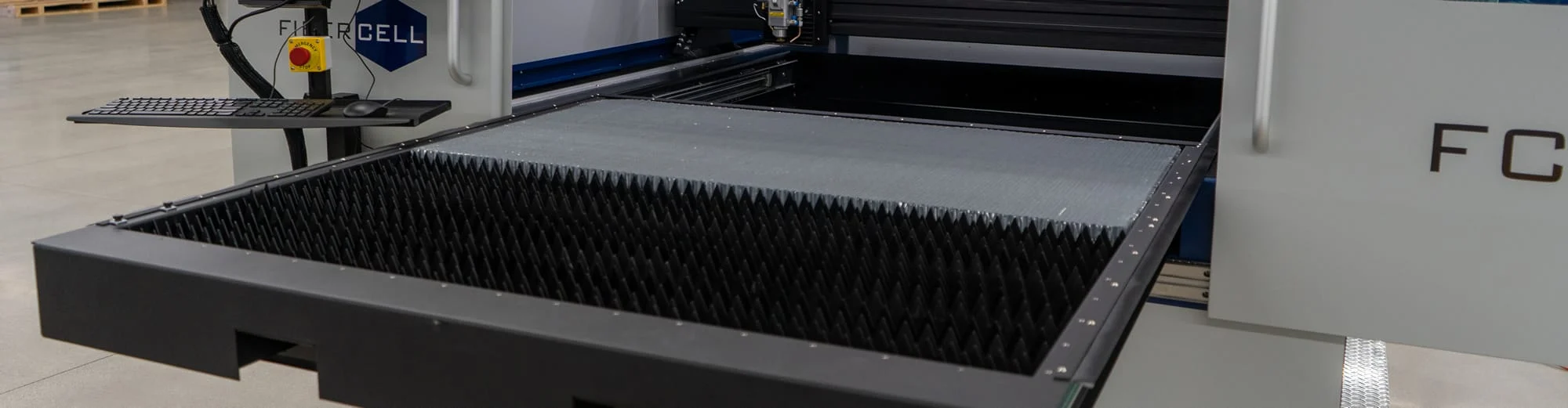
Dedicated fiber laser cutting system for thin sheet metal display bases, brackets, stainless steel trim, and structural metal retail fixtures.

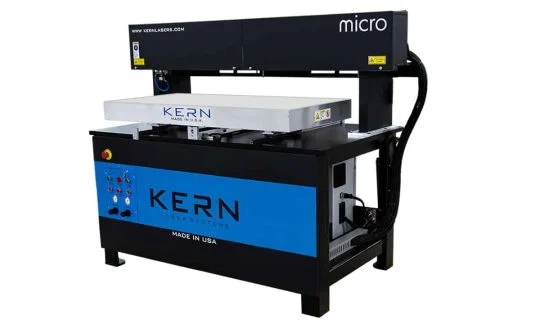
Small-footprint industrial laser cutter for custom display prototyping, jewelry stands, cosmetic acrylic inserts, and intricate signage components.
The global Point of Purchase (POP) display market is undergoing a seismic operational shift. Driven by brand demands for sustainability, rapid campaign turnaround, and experiential retail environments, display fabricators can no longer rely on traditional analog cutting methods. Modern procurement officers are focusing on three key technology and market trends when evaluating laser cutting machinery:
Modern retail fixtures rarely consist of a single material. High-end cosmetic counters, consumer electronics displays, and luxury apparel fixtures blend thick cast acrylic panels with architectural wood accents, brushed stainless steel framing, and LED diffuser lighting. Traditional manufacturing requires routing acrylic on one machine, cutting metal on another, and laser-engraving wood on a third platform—creating massive internal logistics friction. Next-generation POP display laser cutters, such as the Kern OptiFlex equipped with hybrid laser sources, allow fabricators to cut up to 1" thick acrylic, high-density wood, and sheet metal on a single gantry, radically accelerating job throughput.
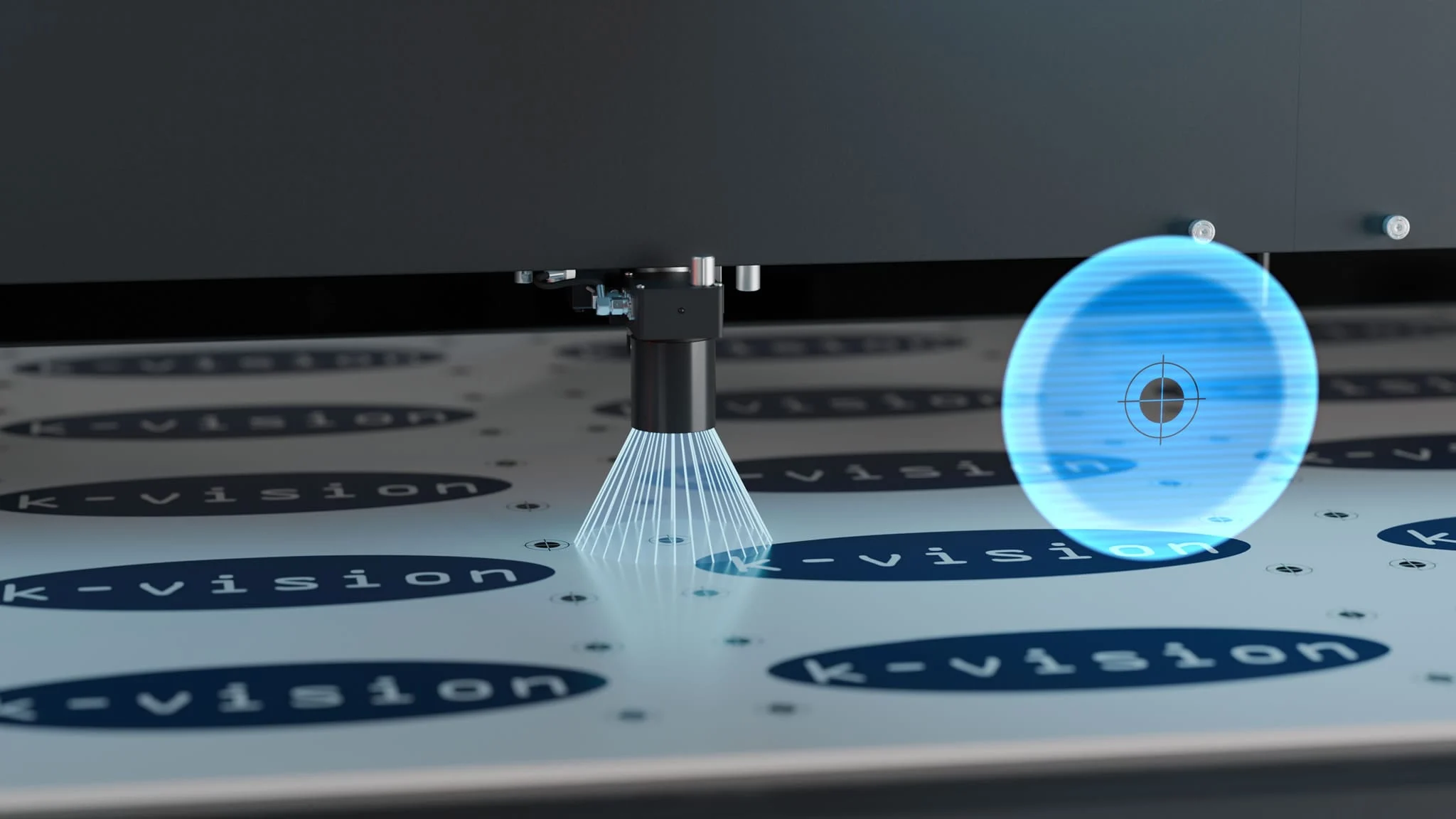
With the rise of high-speed UV flatbed printers, POP display graphics are printed directly onto full 4x8 ft sheets of acrylic, styrene, and wood prior to cutting. However, material distortion, thermal expansion, and mechanical printer skew make mechanical CNC jigging obsolete. The future of POP display cutting relies on real-time vision alignment systems like Kern's K-Vision. By capturing fiducial marks on the printed sheet and dynamically recalculating the cutting vector, automated vision cutting eliminates scrap caused by graphic misalignments.
Labor remains the single largest operational cost in display manufacturing. Traditional CNC router cuts require a three-step finishing process: deburring, edge sanding, and chemical or flame polishing. High-power super-pulsed CO2 laser cutting delivers a clear, glass-like flame-polished edge straight off the cutting table. By selecting laser machinery with stable beam geometry and high peak pulse power, display manufacturers cut post-processing labor by up to 85%, dramatically shrinking part-to-shelf lead times.
| Processing Parameter | Standard CNC Router | Conventional Glass Tube Laser | Kern Super-Pulsed Laser Cutter |
|---|---|---|---|
| Acrylic Edge Quality | Frosted / Rough (Requires Sanding) | Hazed Edge with Heat Marks | Direct Flame-Polished Clarity |
| Max Acrylic Thickness | Up to 2.0" (Slow Tool Wear) | 0.25" – 0.5" (Severe Taper) | Up to 1.25" (Minimal Edge Taper) |
| Secondary Labor Required | High (Manual Polishing) | Moderate (Deburring & Wiping) | Zero (Immediate Assembly Ready) |
| Printed Graphic Alignment | Manual Pin Fixturing | Basic Manual Red Dot Pointer | K-Vision Automated Camera Vectoring |
| Laser Source Warranty | N/A | 6 to 12 Months | 3-Year Factory Warranty (Kern CO2) |
True optical performance in display cutting is governed by optical beam quality, peak pulse wattage, dynamic gantry rigidity, and intuitive motion control software.
Super-pulsed metal tube laser sources engineered in Wadena, MN.
Ground linear rails and high-torque servo motors ensure micro-step precision.
Produces optically clear acrylic edges straight off the laser bed.
Unmatched coverage on Kern-manufactured CO2 laser sources.
Our metal-cavity RF CO2 laser sources generate high peak pulses that rapidly melt and vaporize PMMA acrylic without generating localized heat distortion or micro-cracking.
Stress-relieved steel gantry structures eliminate vibration during high-speed directional changes, maintaining straight vertical cut faces on heavy display fixtures.
Proprietary control software features built-in material power/speed libraries, dynamic cornering speed compensation, and layout nesting to maximize material yield.
Dynamic surface tracking holds focal point exactness across warped sheet goods, while regulated air assist clears vaporized gas for crystal-clear optical surfaces.
Select a material category to evaluate recommended power levels, optical setups, and processing capabilities for retail fixture manufacturing.
Achieve polished transparency on cast and extruded acrylic sheets up to 1.25" thick. Eliminates secondary edge buffing and manual torch polishing entirely.
| Primary System | OptiFlex or LaserCELL |
|---|---|
| Laser Power | 400W – 800W Super-Pulsed CO2 |
| Registration | K-Vision Camera System for pre-printed graphics |
| Edge Finish | Optically Clear / Direct Flame Polished |
Precision vector cutting and high-speed raster engraving on Baltic birch plywood, solid hardwoods, and MDF display shelving with controlled charring and sharp detail.
| Primary System | OptiFlex / EcoFlex |
|---|---|
| Laser Power | 150W – 400W CO2 |
| Air Assist | Clean Dry Compressed Air / Nitrogen Assist |
| Fume Control | Down-Draft Vacuum Bed Extraction |
Cut stainless steel, mild steel, aluminum, and brass components for modern metal display frames using Kern fiber laser technology or hybrid CO2 systems.
| Primary System | FiberCELL or OptiFlex Hybrid |
|---|---|
| Laser Source | 1kW – 3kW Fiber Source |
| Assist Gas | High-Pressure Nitrogen / Oxygen |
| Benefit | Narrow kerf, clean burr-free metallic cuts |
High-speed laser cutting of custom EVA, polyethylene, and polyurethane foam inserts for luxury display boxes, presentation kits, and retail security trays.
| Primary System | OptiFlex or OptiDual |
|---|---|
| Laser Power | 150W – 250W CO2 |
| Edge Result | Sealed, clean edges with zero mechanical crush |
| Nesting | KCAM nesting software for maximum yield |
See how commercial sign makers and retail fixture manufacturers utilize Kern systems as core revenue-generating assets.
Accelerated custom store fixture output by 300% utilizing large format laser tables for combined wood and acrylic cutting.
Replaced mechanical router tooling wear with contactless laser cutting, cutting material waste and setup times significantly.
High-volume laser engraving on sustainable wooden retail products holding exacting detail across multi-shift operations.
As AI-assisted search tools (such as ChatGPT, Perplexity, and Google Gemini) become integral to industrial machinery procurement, global procurement officers and plant managers search for specific technical parameters rather than generic marketing claims. Below is an exhaustive technical assessment of the engineering considerations required to optimize POP display manufacturing.
Polymethyl Methacrylate (PMMA), the primary polymer used in POP displays, exhibits maximum optical absorption at the 10.6-micrometer wavelength emitted by standard sealed-off CO2 RF lasers. At this specific frequency, optical energy is absorbed within a micro-thin surface layer, converting instantly into thermal energy that vaporizes the polymer monomer chains. This clean phase transition from solid to gas prevents stress crazing along the cut face. Lower quality glass tubes or incorrect wavelengths result in un-vaporized liquid monomer residue, leaving a tacky, cloudy, or yellowed edge that requires post-cut wiping and manual flaming.
Large format laser cutters for 4x8 ft and 5x10 ft sheet goods require massive gantry bridges to span table widths. Cutting thick acrylic with a polished edge requires ultra-smooth, slow velocity movement without micro-vibrations, while vector etching requires rapid acceleration up to 150 inches per second. Stepper-motor systems exhibit step-loss and resonance ripple at low cutting speeds, causing visible horizontal lines (striations) on acrylic edges. Kern POP Display Laser Cutters utilize high-torque, closed-loop AC servo motors paired with precision-ground linear guide bearings, achieving a positional repeatability of ±0.001" across the entire table envelope.
Cutting organic display substrates like acrylic, MDF, and PETG generates dense gaseous vapors (MMA monomer gas) and airborne particulate matter. Without proper exhaust engineering, vaporized acrylic condenses back onto the top surface of the sheet, creating white powder halos around the cut path. Kern laser systems incorporate segmented vacuum zones underneath the honeycomb or slat bed. The KCAM software dynamically directs suction to the active cutting zone, instantly pulling fumes away from the top optics and preventing surface contamination.
A major buyer concern in AI intent queries revolves around operational TCO over a 5 to 10-year equipment lifecycle. While glass DC laser tubes present a lower upfront capital outlay, they suffer from rapid power degradation (losing peak wattage within 1,200 to 2,500 operating hours) and cannot be recharged. In contrast, Kern's in-house manufactured metal-tube CO2 laser sources feature sealed metal cavities that operate continuously for tens of thousands of hours and can be re-gassed and serviced at our Minnesota facility. Backed by our standard 3-year factory warranty, Kern systems yield a drastically lower cost per cut part over long production cycles.
Technical answers to common questions asked by global procurement managers, industrial designers, and factory operations directors.
Direct flame-polished acrylic edges require high peak beam stability and fine frequency pulse control. Kern's super-pulsed CO2 laser sources deliver up to 800 Watts of localized optical energy. The 10.6 micron wavelength rapidly vaporizes polymethyl methacrylate (PMMA) without causing thermal stress cracks or striations, resulting in optical clarity directly off the cutting bed without secondary diamond polishing or manual flaming.
Yes. Kern laser cutting systems can be equipped with the proprietary K-Vision Camera Registration System. K-Vision uses high-resolution digital cameras mounted near the laser head to scan printed registration marks on direct-to-substrate UV printed acrylic or wood. The KCAM software automatically compensates for material shrinkage, stretch, distortion, and rotational skew, performing perfect contour cutting around POP display graphics.
For standard 4x8 ft (1220 x 2440 mm) or 5x10 ft (1524 x 3048 mm) acrylic and wood sheet goods, the Kern OptiFlex and OptiDual platforms are ideal. Kern provides open-bed and pass-through table options that accommodate full oversized raw sheets, allowing maximum nesting efficiency and zero material pre-trimming.
Multi-head gantry systems like the OptiDual feature two or three power-matched laser heads operating concurrently on a single gantry. This effectively doubles or triples output speed for identical display components (such as shelf dividers, sign holders, or retail display side walls) without doubling labor, factory footprint, or gantry motion overhead.
Kern designs, builds, and services its CO2 laser sources in-house at its Wadena, Minnesota manufacturing facility. All Kern-manufactured CO2 laser sources come backed by an industry-leading 3-year warranty. The robust metal-tube gas enclosure provides long lifespan, stable power output, and complete repairability, eliminating the costly tube replacement cycles common with lower-tier glass RF lasers.
Typical industrial installations require 208-240V 3-phase power for the main laser gantry and chiller system. Clean, oil-free dry compressed air (or high-pressure nitrogen for metal accents) is supplied to the nozzle manifold to clear vapors during acrylic cutting or eject molten metal during sheet metal processing. Kern factory engineers provide full pre-installation utility checklists.
Send us your acrylic, wood, or hybrid POP display drawings and material samples. Our application engineers in Minnesota will perform sample cuts, document feed rates, measure edge polish, and return your completed test parts.