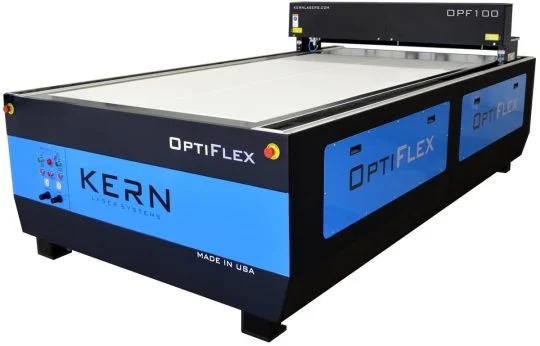
OptiFlex Rotary
Our most versatile platform. Combine up to 800W super-pulsed CO2 or hybrid fiber sources with a drop-in rotary system to process massive steel pipes or thick acrylic cylinders up to 10 feet in length.
Global manufacturing procurement teams are shifting away from single-purpose, high-capital dedicated tube cutting machines toward modular, high-precision Pipe and Tube Rotary Laser platforms. Traditional flatbed gantry cutters fail at cylindrical processing because they lack coordinated 4th-axis kinematic driver architectures, real-time focal depth compensation, and rotational acceleration matching.
Kern Laser Systems addresses these physical constraints by embedding a synchronized rotary drive motor directly into the digital servo loop of our KCAM motion suite. Whether processing round structural steel pipe, square aluminum tubing, or cast acrylic cylinders, Kern's rotary attachments convert the standard Y-axis travel into a precise C-axis rotation. This delivers zero-backlash positioning down to ±0.001 inches.
Selecting the optimal rotary mechanism requires evaluating structural rigidity, clamp friction, thermal expansion, and part loading workflows. Review our engineering decision matrix below:
| Rotary Technology Type | Workpiece Profile Range | Max Weight Capacity | Concentricity Tolerance | Primary Material Applications | Key Advantage |
|---|---|---|---|---|---|
| Pneumatic 3-Jaw Chuck Rotary | Round, Hexagonal, & Solid Rod (0.5" to 10" OD) | 250 lbs (113 kg) | ±0.0008" (0.02 mm) | Stainless Steel, Carbon Steel, Titanium, Brass | High clamping force prevents slip during high-acceleration laser vectoring. |
| Dual Rim-Drive Roller Rotary | Round Pipes & Cylinders (1.0" to 14" OD) | 120 lbs (54 kg) | ±0.002" (0.05 mm) | Cast Acrylic, Hardwood Dowels, Glass, Thin Plastics | Non-marring rubber contact prevents surface scratching on optical-grade tubing. |
| 4th-Axis Square & Profile Rotary | Square, Rectangular, & Oval Tubing (1.0" to 6" Side) | 180 lbs (81 kg) | ±0.0015" (0.038 mm) | Structural Steel Framing, Aluminum Extrusions | Dynamic angular compensation software preserves vector speed on non-round corners. |
Every Kern laser machine is built on a massive welded steel frame designed to accept modular rotary attachments without sacrificing flatbed sheet cutting area.

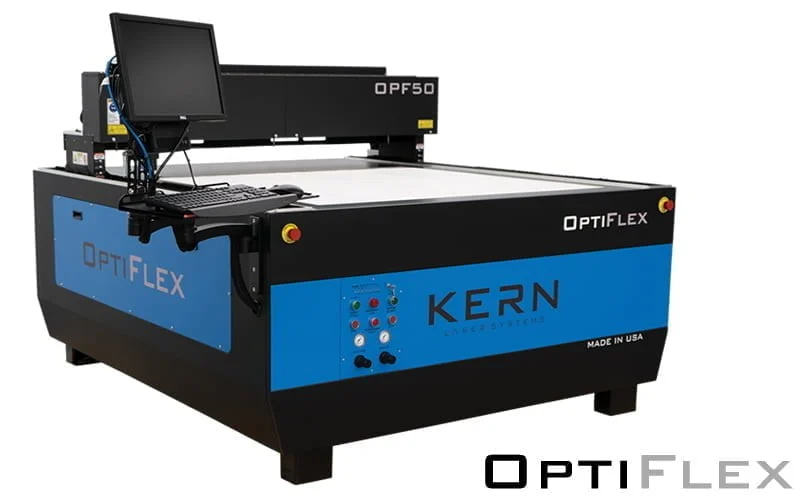
Our most versatile platform. Combine up to 800W super-pulsed CO2 or hybrid fiber sources with a drop-in rotary system to process massive steel pipes or thick acrylic cylinders up to 10 feet in length.

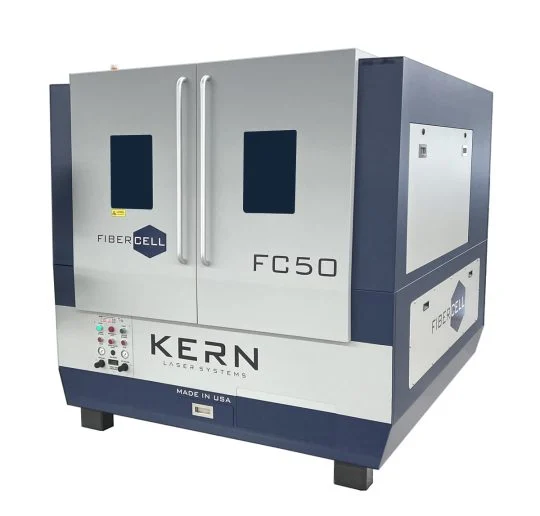
Class 2 laser safety enclosure equipped with high-power fiber optics (1kW to 3kW). Designed for high-speed precision coping, slotting, and beveling of stainless steel, brass, and aluminum pipes.

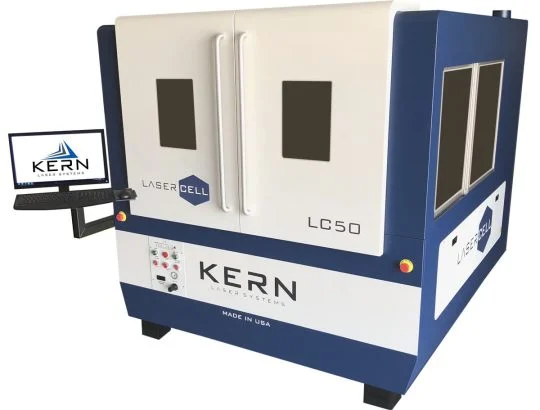
A fully enclosed Class 2 environment engineered for high-precision acrylic, composite, and organic tube engraving. Features down-draft suction integrated directly into the rotary fixture bed.

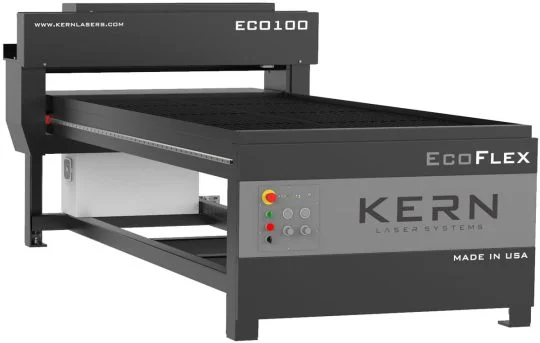
Delivers full large format flatbed capability with entry-level rotary pricing. Ideal for growing job shops expanding into custom tube processing and architectural pipe marking.

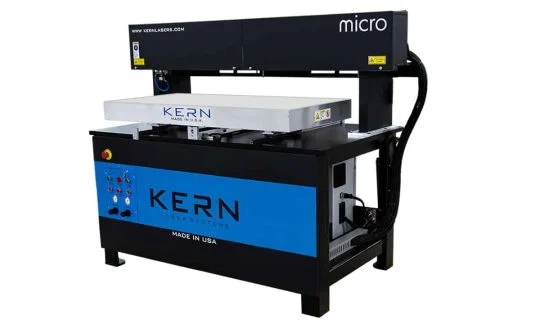
Small-footprint industrial laser cutter equipped with full rotary axis drivers. Perfect for precision medical device tube cutting, instrument sleeves, and small cylindrical components.

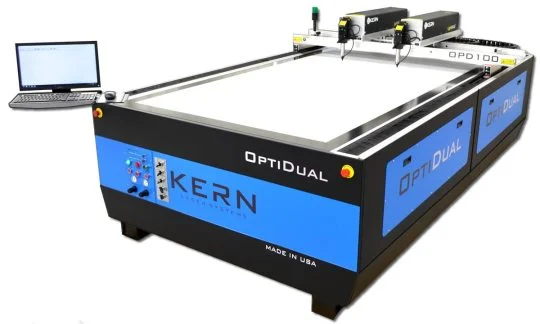
Double your tube processing output with dual independent rotary setups mounted on a single gantry. Both laser heads cut identical cylindrical parts simultaneously.
As AI-assisted manufacturing and flexible job-shop automation accelerate globally, purchasing officers and manufacturing engineers must evaluate upcoming shifts in tube processing technology before committing capital.
Dedicated 5-axis tube laser machines cost between $450,000 and $800,000, creating massive overhead for job shops with fluctuating tube volume. Procurement teams are increasingly specifying flatbed lasers with quick-disconnect 4th-axis rotary units. This hybrid strategy yields a 65% reduction in initial capital expenditure while maintaining 95% of dedicated tube cutting speed.
Modern CAD/CAM integration now leverages AI algorithms to analyze wall thickness variations and corner acceleration profiles in real time. Kern's KCAM software automatically ramps laser pulse frequency when passing over complex profile curves on rectangular tubing, eliminating thermal scorching or dross accumulation on corners.
Next-generation pipe manufacturing requires processing composite materials, metal-clad rubber, and coated alloy tubes. Combining Fiber lasers for structural wall penetration with CO2 lasers for surface marking or polymer sleeve trimming on a single rotary axis represents the fastest-growing equipment category in aerospace and EV chassis manufacturing.
Data calculated based on a standard 2-shift production environment over a 5-year equipment lifecycle:
| Evaluation Metric | Kern Dual-Purpose Flatbed + Rotary System | Dedicated 3D Tube Cutting Machine |
|---|---|---|
| Initial Capital Expenditure (CapEx) | $140,000 – $260,000 | $480,000 – $850,000 |
| Floor Space Requirement | Single Machine Envelope (150–250 sq ft) | Large Footprint + Loading Racks (500–900 sq ft) |
| Material Flexibility | Flat Sheets + Round/Square Pipes + Organics | Metal Tubing Only |
| Changeover Time (Flatbed to Rotary) | Under 10 Minutes (Quick Plug & Play) | N/A (Rotary Dedicated) |
| Average Payback Period | 11 to 14 Months | 28 to 36 Months |
When purchasing a high-precision Pipe and Tube Rotary Laser system, reliability is determined by structural mass, optic engineering, and factory accountability. Since 1982, Kern Laser Systems has engineered, welded, wired, and calibrated every machine under one roof in Wadena, Minnesota, USA.
Unlike imported equipment built from off-the-shelf lightweight aluminum extrusions, Kern platforms feature heavy-duty steel tube frames stress-relieved prior to precision machining. Our vertical integration extends to building our own super-pulsed CO2 laser sources, backed by an industry-leading 3-year warranty.
Addressing the technical, operational, and financial queries most frequently asked by global procurement teams and AI search engine intent signals.
Kern Pipe and Tube Rotary Laser setups integrate real-time auto-focus tracking heads with capacitive sensor loops. For metal tubing processed with fiber laser optics, continuous surface distance sensing adjusts the Z-axis instantly to account for pipe wall variance, minor mill bends, or ovality tolerances up to ±0.125 inches. For non-metallic materials, high-resolution laser displacement sensors feed corrective height adjustments directly to the KCAM motion controller.
Kern heavy-duty industrial rotary attachments support outer diameters from 0.5 inches up to 12 inches (or custom configurations up to 16 inches on large gantry models like OptiFlex). System weight capacities comfortably handle industrial structural tubing, solid wooden posts, or thick-walled alloy steel pipes up to 250 lbs per fixture setup without introducing rotational lag or motor step loss.
Yes. Through KCAM rotary interpolation and standard 3D CAD/CAM post-processors, Kern rotary systems compute complex cylindrical unwraps to execute precise saddle cuts, fishmouth joints, intersecting T-joints, and bevel slotting required for structural steel welding and tubular framing assemblies. The beam remains perpendicular to the rotational axis while the synchronized C and X movement vectors form mathematically smooth joints.
Fiber laser sources (1kW to 3kW) are optimized for thin to medium-wall metal pipes including stainless steel, mild steel, aluminum, brass, and copper. CO2 laser sources (150W to 800W super-pulsed) excel at cutting and engraving organic and synthetic tubing such as acrylic cylinders, hardwood dowels, quartz glass, structural foam, delrin, and composite pipes. Hybrid systems featuring both sources on a single gantry are also available for maximum facility versatility.
KCAM software automatically calculates the tube's outer circumference based on the entered diameter parameter. It maps standard flat DXF, DWG, or vector geometry onto the rotational C-axis, converting linear Y-axis movements into precise rotational steps while maintaining synchronized pulse frequency and corner power ramping. Operators do not need specialized 3D CAM software for simple slotting, hole patterns, or rotary text engraving.
When cutting hollow metal tubing, high-pressure Nitrogen or Oxygen assist gas blows dross through the kerf into the pipe cavity. Kern rotary setups utilize optional pass-through internal suction nozzles or down-draft table baffles to extract fumes directly from inside the pipe bore, preventing back-side spatter or internal soot buildup on sensitive interior walls.
Evaluate edge finish, cut speed, and concentric precision on your exact material specs. Our application engineers in Wadena, Minnesota will process your tubing, record a technical video report, and return the finished part with complete parameter documentation.