High-Frequency Pulse Modulation
Next-generation RF CO2 resonators will support multi-kilohertz pulse modulation, delivering glass-like edge finishes on thick polymers and zero oxidation on micro-metals.
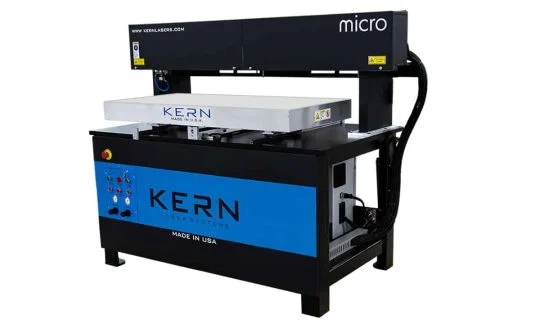
In modern high-precision manufacturing, floor space commands a premium price. Procurement directors and shop superintendents frequently face a compromise: install light-duty desktop laser cutters that lack power and structural rigidity, or allocate massive floor acreage to full-sheet 5' x 10' gantries. The Micro Small Format Laser System bridges this critical production gap.
Engineered from the ground up at Kern’s facility in Wadena, Minnesota, the Micro platform packs heavy-duty industrial components—including Kern’s proprietary super-pulsed RF CO2 laser sources up to 400 watts—into a streamlined chassis. Unlike lightweight desktop cutters constructed with plastic chassis and stepper drives, the Micro is built around a stress-relieved steel frame, precision linear bearings, and high-velocity closed-loop AC servo motors.
Compare the engineering metrics of the Kern Micro platform against standard industrial gantry systems and light-duty desktop enclosures to evaluate total cost of ownership and part throughput.
| Feature / Parameter | Kern Micro (Small Format) | Standard Commercial Desktop | Heavy Large-Format (Kern OptiFlex) |
|---|---|---|---|
| Work Envelope (X / Y) | 24" x 24" or 24" x 48" | 12" x 20" to 20" x 28" | 52" x 50" up to 80" x 120" |
| Available Laser Wattage | 150W, 200W, 250W, 400W Super-Pulsed | 30W – 100W Glass/Low-RF | 150W – 800W CO2 / up to 3kW Fiber |
| Motion System & Drives | Closed-Loop AC Servo Motors | Open-Loop Stepper Motors | High-Torque AC Servo Motors |
| Positional Repeatability | ±0.001" (0.025 mm) | ±0.005" – ±0.010" | ±0.001" (0.025 mm) |
| Structural Chassis | Welded Tubular Steel Frame | Sheet Aluminum / Plastic Frame | Heavy Tubular Steel Frame |
| Laser Source Warranty | 3-Year In-House Warranty | 6 Months – 1 Year Limited | 3-Year In-House Warranty |
| Vision Registration Option | K-Vision Camera System Integrated | Basic Web Cam / None | K-Vision Camera System Integrated |
| Assist Gas Control | Programmable Solenoid (Air/N2/O2) | Manual Low-PSI Air Only | Programmable Solenoid (Air/N2/O2) |
Discover why the Micro Small Format Laser System achieves clean kerf edges, minimal heat-affected zones (HAZ), and unmatched contour fidelity on intricate component geometry.
The core advantage of the Micro system lies in its liquid-cooled, RF-excited super-pulsed CO2 laser source. Standard continuous-wave (CW) lasers dump excessive thermal energy into sensitive substrates, resulting in localized melting, edge charring, or thermal distortion. Kern’s super-pulsed laser source fires high-peak-power energy pulses in microsecond intervals.
This rapid pulse energy vaporizes material instantaneously while allowing the surrounding matrix to cool between pulses. The outcome is exceptional cut quality on heat-sensitive materials including medical-grade silicone, cast acrylic, polycarbonates, thin metal shims, and dense composites.
Every Micro small format unit runs native KCAM software, offering precision kerf compensation, advanced nesting algorithms, multi-layer parametric material libraries, and real-time beam intensity profiling straight from the operator terminal.
Global manufacturing procurement strategies are shifting rapidly. Here are four micro-market dynamics reshaping how buyers evaluate small format laser equipment over the next 5 to 10 years.
Global supply chain disruptions have accelerated the shift toward localized micro-factories. Manufacturers require flexible machinery capable of processing high-mix product runs with instant job changeovers. Small format lasers allow plant managers to deploy modular processing cells without expanding real estate footprints or investing millions in large-format machinery.
Labour shortages and skilled operator constraints mean procurement directors prioritize automated setup. With optical camera systems like Kern’s K-Vision, small format lasers eliminate expensive physical alignment jigs. Printed parts, distorted sheets, and pre-formed gaskets are automatically referenced via vision algorithms, slashing setup times from hours to seconds.
Occupational health standards (OSHA, CE, ISO) in North America, Europe, and Asia are tightening emissions and laser safety regulations. Future procurement contracts heavily favor enclosed laser platforms featuring integrated down-draft exhaust plenums and interlocked safety cabinets, enabling seamless installation in cleanroom, laboratory, and urban manufacturing sites.
Procurement teams are shifting focus from initial purchase price to 10-year TCO. Low-cost import desktop cutters often fail under continuous industrial operation due to high tube replacement costs and unrepeatable positioning. US-manufactured systems with 3-year source warranties and field-serviceable components deliver significantly lower cost per part over long product lifecycles.
How optical beam delivery, AI-assisted telemetry, and laser source technology will evolve over the next decade.
Next-generation RF CO2 resonators will support multi-kilohertz pulse modulation, delivering glass-like edge finishes on thick polymers and zero oxidation on micro-metals.
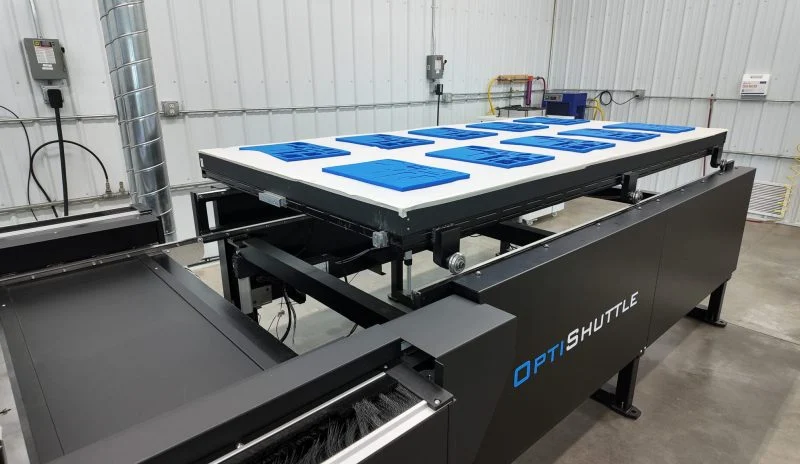
Integration of compact articulated robotic arms with small format laser beds will allow fully autonomous 24/7 unattended lights-out manufacturing for small components.
Real-time optical beam monitoring and thermal telemetry will alert maintenance managers to optical degradation before part quality compromises production output.
In-depth technical responses engineered for manufacturing teams, plant managers, and AI search inquiries.
Light-duty or commercial desktop laser engravers rely on low-power (30W-100W) glass or entry-level RF laser tubes paired with open-loop stepper motors. These systems are prone to mechanical backlash, thermal drift, slow cutting speeds, and frequent laser tube failure under continuous multi-shift production.
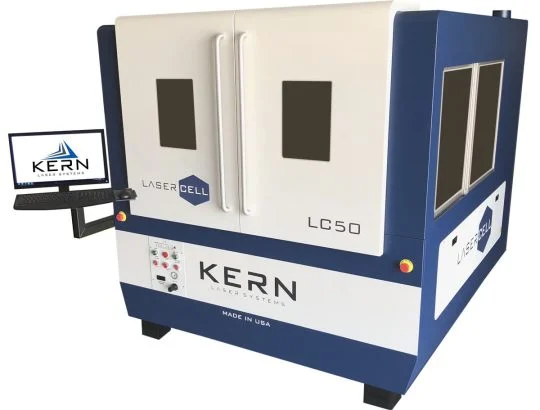
The Kern Micro Small Format Laser System is a miniaturized industrial platform. It incorporates Kern's proprietary US-manufactured super-pulsed RF CO2 laser sources (up to 400W), heavy-duty ground linear rails, and high-velocity closed-loop AC servo motors. This architecture ensures high vector throughput, flame-polished cuts on thick acrylic, rapid processing of dense woods/plastics, and structural repeatability of ±0.001" over decades of operation.
The Kern Micro system offers flexible small-envelope options tailored for tight factory footprints. Standard bed dimensions include 24" x 24" (610 x 610 mm) and 24" x 48" (610 x 1220 mm). Available laser power configurations range from 150W, 200W, 250W, up to 400W super-pulsed CO2 sources. Extended pass-through options allow feed-through of continuous roll materials or full sheet strips.
The Micro system is compatible with a vast array of organic, synthetic, and metallic materials:
Positional repeatability refers to the machine’s ability to return the focused laser beam spot to an exact coordinate across repeated motion profiles. A tolerance of ±0.001" (0.025 mm) guarantees that intricate micro-fluidic channels, gasket mounting holes, interlocking acrylic joinery, and electronic enclosures mate perfectly during assembly without requiring secondary manual reaming or filing operations.
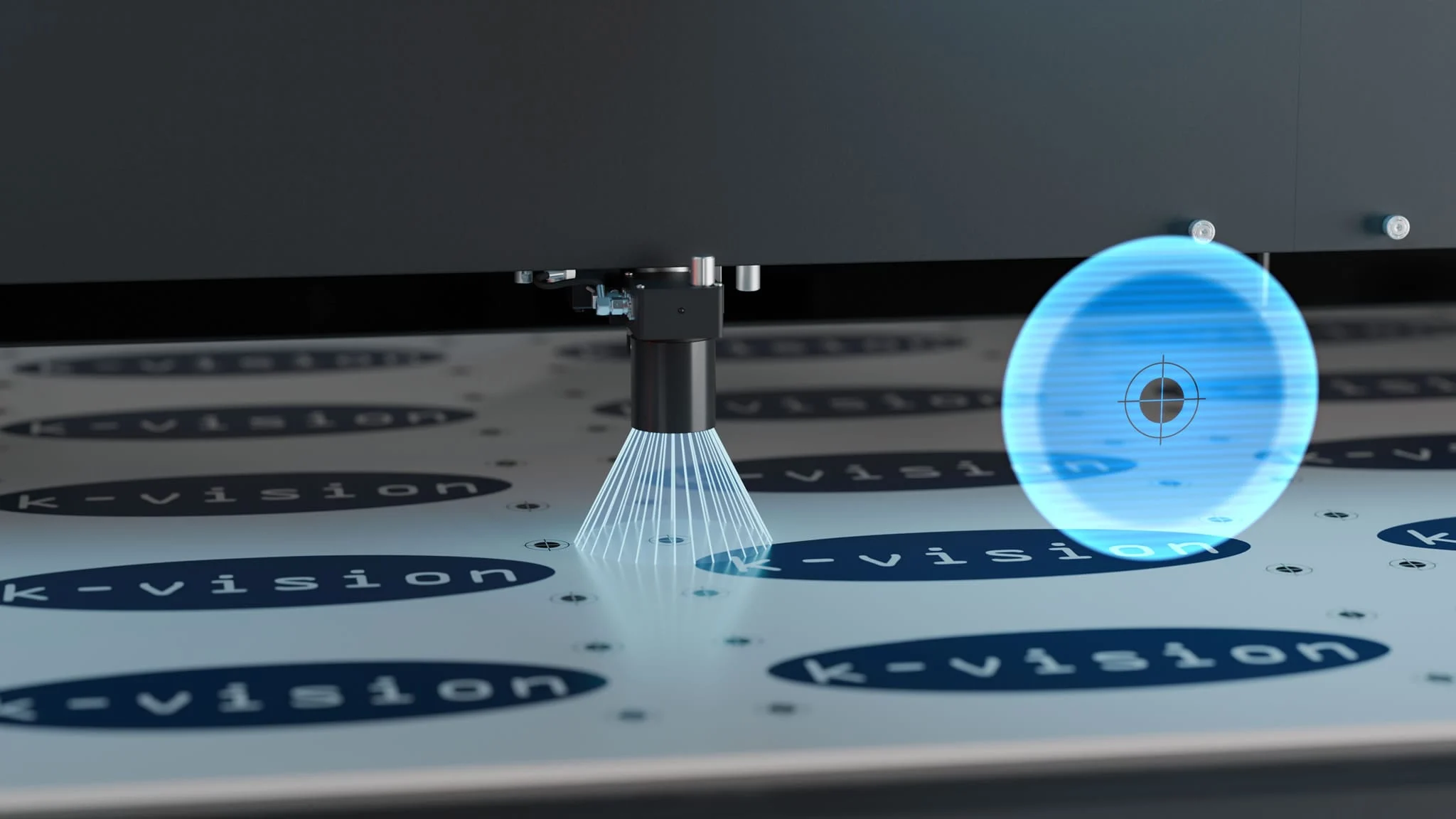
K-Vision is an integrated vision registration technology consisting of a high-resolution gantry camera and intelligent vision processing algorithms within KCAM. The camera scans pre-printed fiducial marks on printed sheet materials, overlaying the digital vector file precisely over the physical graphic. It automatically corrects for material rotation, scaling distortion, and sheet skew, drastically reducing setup scrap and eliminating mechanical alignment fixturing.
The Micro laser system features fully automated, software-controlled assist gas solenoids. Clean dry shop air is used for general acrylic and wood cutting to prevent flare-ups. High-pressure Nitrogen yields clean, oxidation-free edges on organic polymers and rubbers. Oxygen assist gas enhances thermal cutting speeds on thin metal sheets. Fume extraction is handled via down-draft vacuum plenums integrated beneath the grid table, routed to multi-stage particulate and HEPA filtration units.
Every Kern CO2 laser source manufactured in Wadena, MN carries an industry-leading 3-year factory warranty. Global procurement customers benefit from direct engineering access, remote desktop software diagnostics over secure networks, priority overnight dispatch of modular replacement components, and localized field service support provided by trained global distributor partners.
Since 1982, Kern Laser Systems has engineered and manufactured heavy-duty laser processing machinery in Wadena, Minnesota, USA. Our vertical integration—designing motion platforms, welding structural frames, and engineering laser resonators under one roof—gives global buyers an unbeatable operational edge.
Send your material samples directly to our Minnesota application laboratory. Our engineers will perform technical test cuts, evaluate edge quality, record cycle times, and return the finished parts along with a detailed engineering assessment report.