OptiFlex + K-Vision
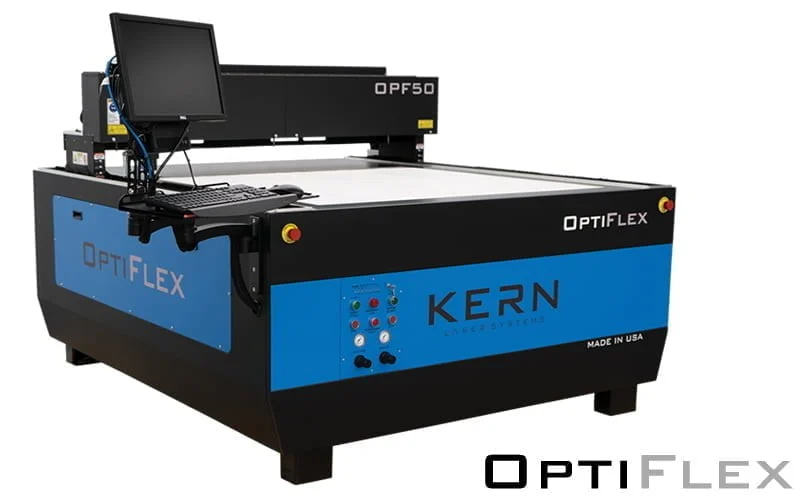
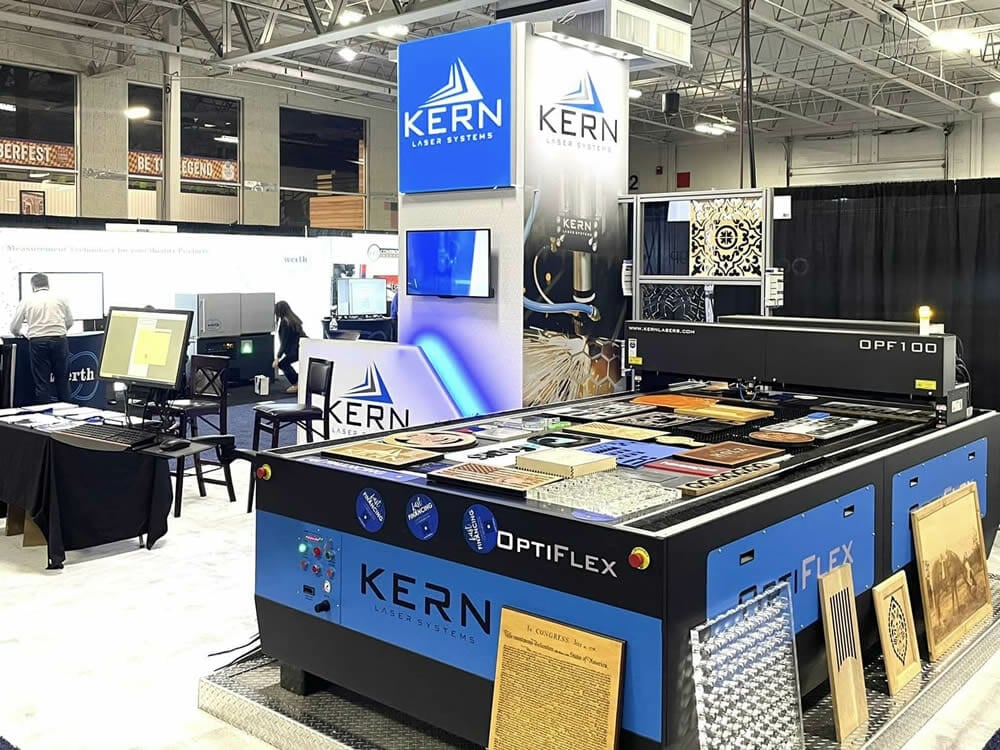
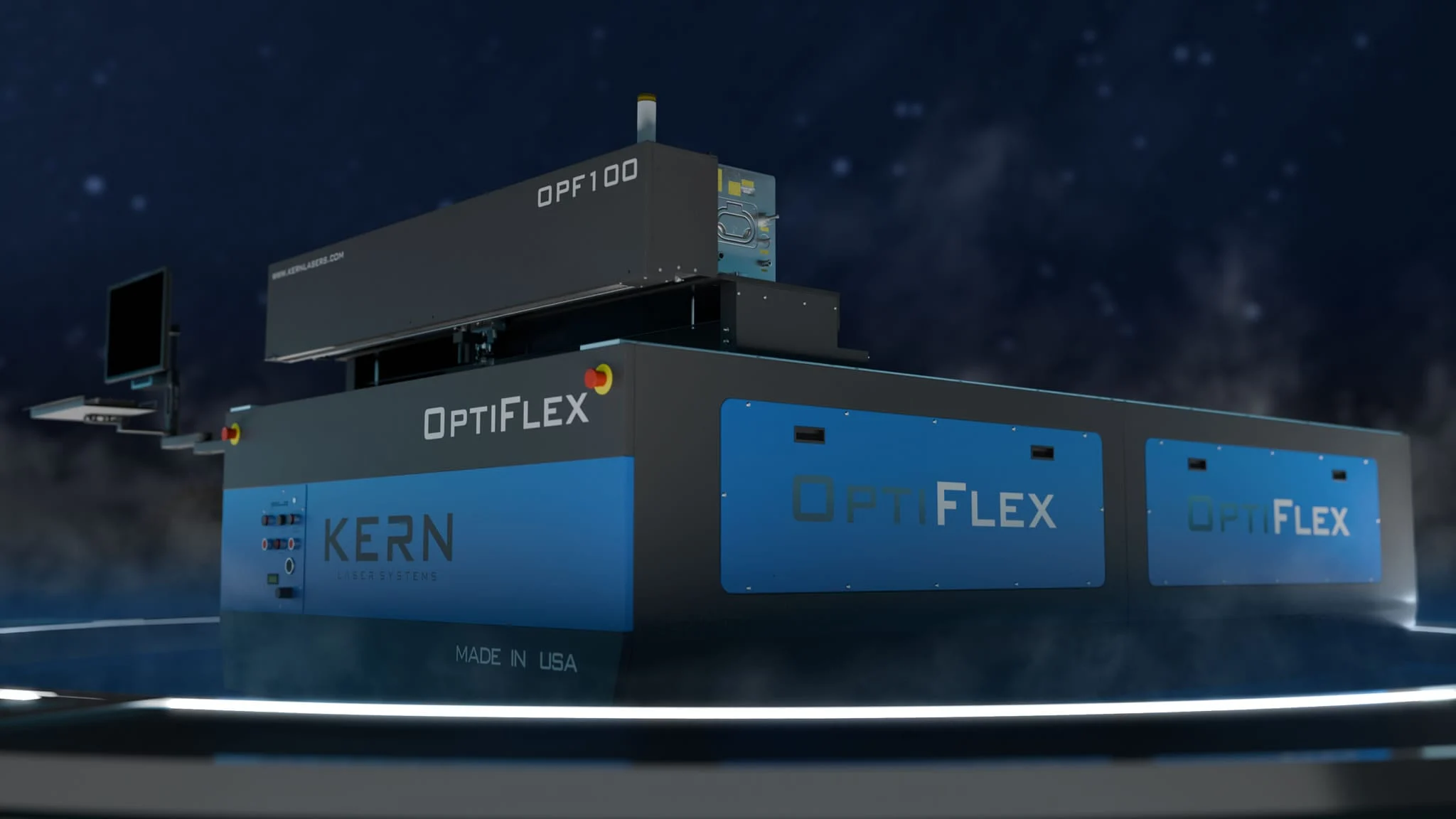
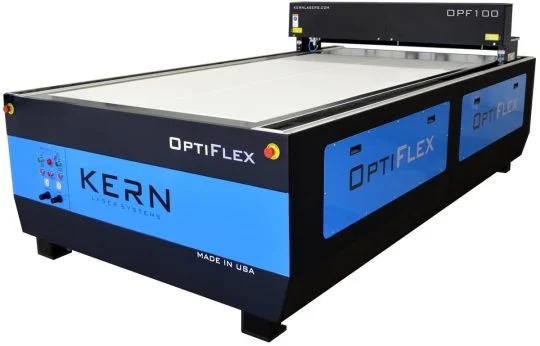
The flagship large-format platform for processing 4x8 ft and 5x10 ft preprinted sheet goods. Cuts 1" acrylic with flame-polished edges aligned precisely to printed graphics.
In high-capacity digital printing and industrial manufacturing, zero-defect part cutting depends entirely on alignment accuracy. Traditional mechanical stop pins and edge squaring assume that every sheet is perfectly rectangular and every print job perfectly square. In reality, thermal curing, dye-sublimation heating, humidity shifts, and substrate stretch introduce non-linear geometric distortions that turn standard CNC cutting paths into expensive scrap.
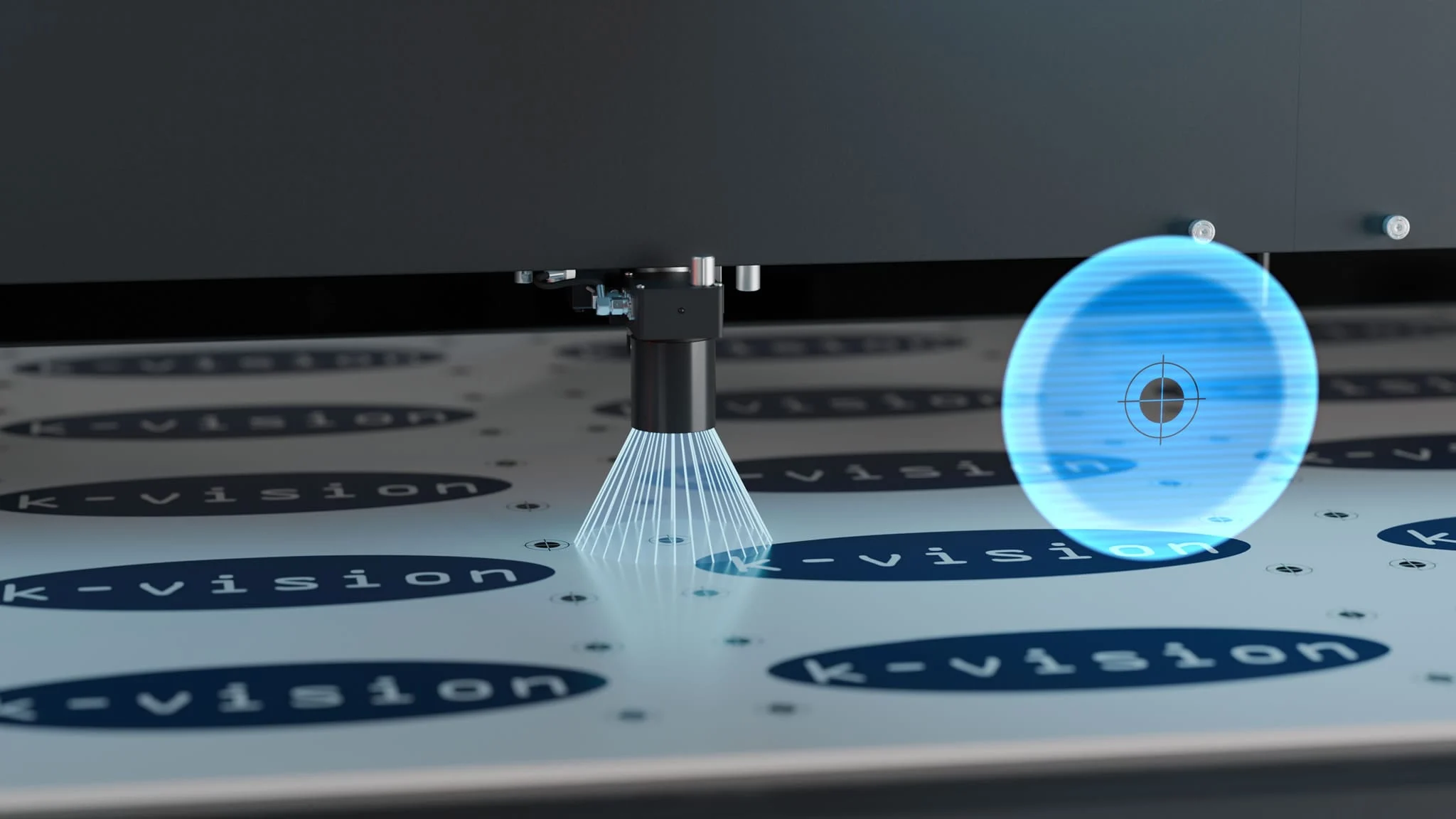
The K-Vision Camera Registration System bypasses mechanical limitations entirely. By mounting a high-speed, high-resolution digital CCD camera assembly directly onto the motion gantry of Kern CO2 and Fiber laser platforms, K-Vision bridges the gap between optical design vectors and real-world material variance.
Global procurement teams and plant directors frequently ask: "Why do standard CNC lasers fail when cutting wide-format preprinted sheets?" The answer lies in the dynamic physics of printed media.
Dye-sublimation fabrics and heat-cured printed acrylic sheets stretch or shrink unevenly across their length. K-Vision reads multi-point fiducials to stretch, shrink, and warp the cutting path in KCAM software to match the physical material perfectly.
Manual alignment requires skilled machine operators to measure offsets, jog the laser head to multiple points, and create physical alignment fences. K-Vision cuts setup times from 15 minutes per sheet down to under 10 seconds.
Whether running high-run flatbed UV digital printers or dye-sublimated textile rolls, K-Vision converts raw print output directly into finished cut parts without secondary manual layout software or intermediate CAD conversion.
Equipped with optimized ring lighting that adjusts contrast automatically. Reads dark marks on light media, white marks on dark substrates, and reflective foils with equal precision.
Unlike third-party add-on cameras that require secondary controllers, K-Vision communicates natively with Kern’s KCAM software, ensuring zero latency between image capture and servo motion execution.
For nested sheet goods containing dozens of smaller printed components, K-Vision rapidly scans local mark arrays to ensure individual part alignment within complex nests.
The K-Vision Camera Registration System is not a standalone accessory—it is an integrated vision suite available across Kern's engineered equipment range. Explore how K-Vision elevates each laser platform.

The flagship large-format platform for processing 4x8 ft and 5x10 ft preprinted sheet goods. Cuts 1" acrylic with flame-polished edges aligned precisely to printed graphics.

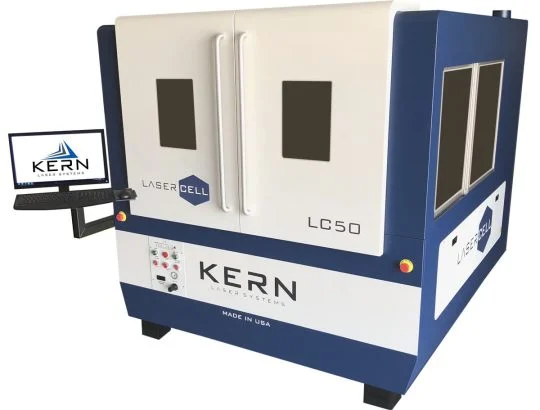
Combines full Class 2 safety compliance with optical vision camera scanning. Excellent for educational institutions, aerospace facilities, and clean industrial shops.

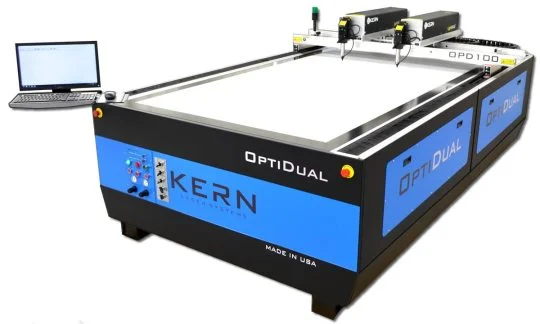
Double your production volume. K-Vision scans registration marks once, instantly assigning offset vectors to dual laser heads for simultaneous contour cutting.
As industrial manufacturing migrates toward Industry 4.0, global buyers must evaluate how camera registration technology aligns with automated supply chains and AI-driven quality assurance.
While current vision systems rely on printed fiducial dots, next-generation procurement standards are pushing toward mark-less registration. Future iterations of K-Vision software are evolving to recognize natural material features, printed outline edges, and internal cut geometries directly, reducing ink consumption and print setup steps.
High-power laser cutting generates localized heat. In continuous production, substrate temperature shifts cause subtle dimensional expansion. Modern optical camera algorithms will continuously scan and recalibrate thermal movement in real-time, holding tolerances under ±0.001" even during extended multi-head laser runs.
Autonomous Mobile Robots (AMRs) and Automated Guided Vehicles (AGVs) are replacing manual material loading. Because robotic pick-and-place systems cannot guarantee exact physical placement on the laser table, the K-Vision Camera Registration System becomes the essential optical link that allows true lights-out manufacturing.
Investing in optical laser machinery requires total confidence in vendor longevity, direct engineering support, and reliable component supply chains.
Designing and manufacturing heavy-duty industrial laser systems in Minnesota, USA since 1982.
In-house engineered super-pulsed CO2 sources backed by the industry's strongest warranty.
Global export reach supported by trained technicians, remote diagnostics, and rapid spare-parts shipping.
Every K-Vision assembly is calibrated and run-tested on solid steel frames prior to international shipment.
Unlike importers who assemble third-party motion decks with off-the-shelf Chinese optical kits, Kern Laser Systems owns the full technology stack. Our machine chassis are heavy-gauge welded steel, engineered and machined in Wadena, Minnesota. Our laser sources are built in-house, and our KCAM motion and vision software is written by Kern software engineers.
When you contact Kern support, you speak directly with the engineers who designed the K-Vision algorithms and built your machine gantry. This direct expertise ensures rapid troubleshooting, seamless software updates, and reliable multi-decade operating life.
Detailed technical answers for machine operators, plant managers, and procurement officers evaluating optical registration laser equipment.
The K-Vision Camera Registration System is an optical visual alignment solution mounted directly to the laser motion gantry. It uses a high-resolution digital CCD optical sensor combined with Kern's KCAM software to automatically detect preprinted registration marks on materials. Once scanned, K-Vision shifts, rotates, and scales the vector cut path to perfectly match the printed graphics, achieving registration repeatability within ±0.002".
This eliminates manual operator alignment errors, prevents expensive substrate scrap caused by print stretch or skew, and removes the need for physical mechanical alignment jigs on the bed.
When materials undergo digital printing, heat curing, UV drying, or dye-sublimation transfer, they rarely deform in a perfectly uniform manner. Synthetic textiles, acrylics, paperboard, and wood veneers often stretch or shrink non-linearly across the X and Y axes.
K-Vision solves this using multi-point mathematical mapping. By capturing 4, 6, 8, or more fiducial marks distributed across the substrate, KCAM software constructs a dynamic transformation matrix. It calculates localized scaling and trapezoidal warping parameters, ensuring that cut vector paths follow the true printed contours across large-format sheet sizes up to 5x10 ft.
K-Vision features versatile visual recognition algorithms capable of identifying standard registration target geometries, including solid dots, open circles, target rings, crosshairs, square boxes, and custom vector shapes.
Thanks to integrated adjustable LED ring lighting and dynamic software contrast controls, K-Vision reliably scans dark ink printed on light substrates, light ink printed on dark materials, and reflective metallic inks across various materials such as acrylic, wood, aluminum composite, corrugated plastic, rubber, and technical textiles.
K-Vision is factory-integrated across Kern's complete CO2 and Fiber laser product lines. Compatible platforms include:
In traditional laser production, machine operators spend considerable non-productive time placing material against physical pins, manually checking squareness with square rulers, or running test pulses to verify alignment. For custom jobs, shops must design and machine expensive custom holding fixtures.
With K-Vision, material loading becomes a fast 'drop-and-cut' process. Operators place preprinted sheets anywhere on the vacuum bed within reasonable rotation tolerance. The camera scans the marks in seconds, automatically establishes origin coordinates, compensates for sheet angle, and starts cutting. This slashes job setup time by up to 90%, increases daily bed utilization, and yields a fast payback period for high-mix manufacturing facilities.
No. Many laser suppliers buy third-party optical vision add-ons that run on separate computer screens with separate license fees and fragmented support workflows. K-Vision is engineered natively inside Kern's KCAM Laser Control Software ecosystem. Camera calibration, mark selection, dynamic offset previewing, and laser motion execution occur inside one unified software interface on the main operator station console.
Every Kern laser system equipped with K-Vision is backed by direct factory engineering support from our Wadena, Minnesota headquarters. Support includes remote desktop diagnostics, high-speed camera calibration routines via secure network connections, detailed step-by-step video documentation, and worldwide spare-parts express dispatch, reinforced by an established international distributor network.
Send our application engineering team your preprinted material samples. We will run them through the K-Vision Camera Registration System on a Kern laser table, document the registration speed, and return the cut parts for your quality inspection.