Top Trusted CO2 Laser Source Equipment Suppliers & Exporters Serving the Indonesia Market

Industrial-Grade CO2 & Fiber Laser Marking, Cutting & Coding Equipment Engineered for High-Humidity Operational Stability & Enterprise Scale Across Java, Sumatra, & Batam

Precision Laser Systems

Featured Industrial Laser Equipment Lineup

High-efficiency laser source machinery specialized for non-metal processing, high-speed coding, and hybrid metal/non-metal direct manufacturing.
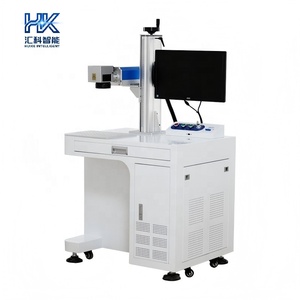
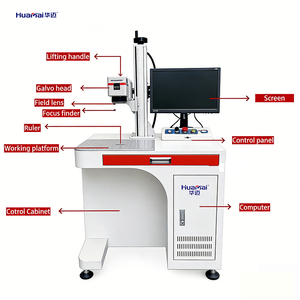
High-Power Industrial Fiber/CO2 Marking Machine 100W 200W 300W

Fiber Laser Marking Machines JPT RAYCUS MAX 100W-300W High Power System

Power: 100W / 200W / 300W
Compatibility: Metals, Hard Plastics, Industrial Alloys
Best For: High-speed Jakarta industrial coding & deep engraving
Portable Auto Focus 20W 30W JPT MOPA Laser Color Printing Machine

Portable Auto Focus 20W 30W JPT MOPA Laser Color Printing & Marking Unit

Laser Source: JPT MOPA M7
Features: Auto Focus, Color Marking, Glass/Metal Engraving
Best For: Electronics packaging & custom stainless color branding
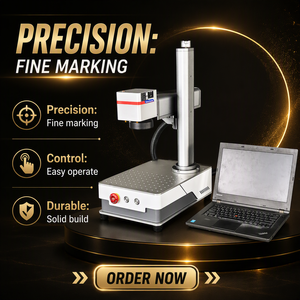
Desktop Mini Fiber Laser Marking Machine 30W

Desktop Mini Fiber Laser Marking Machine Compact Lightweight 30W Marker

Footprint: Ultra-Compact Desk Unit
Materials: Stainless Steel, Brass, Hardware Tools
Best For: Small workspace workshops in Surabaya & Bandung
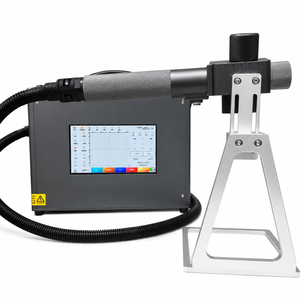
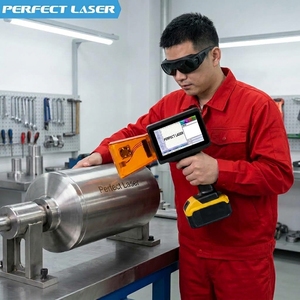
Handheld Mobile Portable Mini Laser Marker 20W 30W 50W

Handheld Mobile Portable Mini 20W 30W 50W Laser Marking & Coding System

Portability: Handheld Scan Head & Mobile Base
Mobility: Flexible angle processing on large workpieces
Best For: Heavy equipment serialization & pipe coding
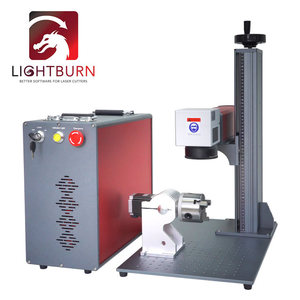
100W JPT M7 MOPA CO2 Fiber Laser Marking Machine

100W JPT M7 MOPA CO2/Fiber Laser Bench-Top System with 80mm Rotary Axis

Work Envelope: 300x300mm + Rotary Axis
Format Support: DXF, PLT, AI, BMP
Best For: Cylindrical items, acrylics, and organic materials
Small Desktop UV Laser Engraving Machine Air Cooling

Small Desktop UV/CO2 Laser Engraving Machine Air-Cooled Packaging Marker

Cooling: Integrated Air Cooling System
Specialization: Zero-Thermal Distortion on Plastics & Glass
Best For: FMCG packaging, cosmetic bottles, medical caps
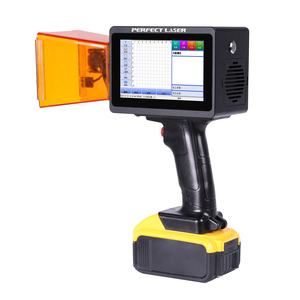
Portable Laser Marker Handheld with Rechargeable Battery

Industrial Handheld Laser Marker with Rechargeable Battery for On-Site Coding

Power Source: Dual AC/DC Rechargeable Battery Pack
Substrates: Metals, Structural ABS, HDPE, Rubber
Best For: Warehouse inventory marking & field maintenance
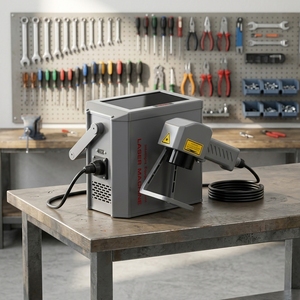
Portable Handheld Laser Marking Machine For Wood Leather Industrial Coding

Multi-Substrate Handheld Laser Marking Machine for Organic Wood & Leather

Beam Type: High-Refining CO2/Fiber Hybrid Option
Substrates: Teak Wood, Genuine Leather, Polymers, Steel
Best For: Indonesian handcrafted export goods & furniture branding
800W
Peak Super-Pulsed CO2 Output
🎯
±0.001"
Positional Precision Repeatability
🛡️
3 Years
Factory Laser Source Warranty
🌏
50+
Global Exporter Export Nations

Whitepaper: Industrial CO2 Laser Systems & Tropical Manufacturing Dynamics in Indonesia

As Southeast Asia's largest economy accelerates its "Making Indonesia 4.0" national strategic roadmap, industrial manufacturing sectors across Greater Jakarta (Jabodetabek - including Cikarang, Karawang, and Bekasi), East Java (Surabaya industrial corridors), and Central Java (Semarang and Jepara) are experiencing a dramatic technological transformation. Central to this industrial upgrading is the transition from mechanical cutting and conventional ink marking to precision non-contact industrial laser equipment.

CO2 laser sources operating at the 10.6 µm wavelength remain the indisputable benchmark for non-metallic substrate processing, including cast acrylic signage, engineered teak plywood, automotive rubber gaskets, synthetic textiles, and food/beverage flexible packaging. However, deploying high-power laser equipment in tropical climates presents distinct operational challenges. Indonesia's high ambient operating temperatures (frequently exceeding 35°C inside production plants) and elevated relative humidity (80%–95% RH) require laser source architectures engineered specifically for thermal resilience and optical integrity.

Key Information Gain: Tropicalized Laser Source Thermal Protection

Standard glass DC CO2 laser tubes experience exponential power degradation and beam mode decay when cooling water temperatures exceed 24°C. Our industrial RF-excited metal tube CO2 laser sources feature sealed ceramic core cavities and integrated multi-zone closed-loop liquid cooling interlocks, preventing optical condensation (sweating) and maintaining stable Gaussian beam quality ($M^2 < 1.2$) even under 24/7 continuous operation in tropical factory environments.

Localized Application Scenarios across Indonesian Key Industries

Understanding regional industrial clusters allows procurement managers to select optimized CO2 and fiber laser configurations aligned with local raw materials and production workflows:

Furniture & Architectural Wood (Jepara & Central Java)

Processing natural teak, mahogany, and commercial plywood requires deep cut penetration without severe edge charring. High-wattage super-pulsed CO2 laser sources deliver peak pulse energy that vaporizes wood lignin instantaneously, leaving smooth, paint-ready dark edges and crisp relief engravings for export-grade furniture.

Automotive & Rubber Gaskets (Cikarang & Karawang)

Tier-1 automotive suppliers require fast, tool-free profile cutting of rubber seals, PE foams, and acrylic light guides. Continuous-wave CO2 laser sources eliminate mechanical tool wear and part distortion, delivering repeatable tolerances within ±0.025 mm for strict OEM quality compliance.

Textile, Footwear & Garments (Bandung & West Java)

Synthetics, polyester knits, and genuine leather cut cleanly under 10.6 µm laser light. The thermal edge-sealing phenomenon inherent to laser processing prevents fabric fraying on activewear and shoe uppers, eliminating secondary edge-hemming processes entirely.

Comparative Technical Specifications: CO2 vs. Fiber vs. UV Source Engineering

Selecting the appropriate laser source type is fundamental to optimizing yield, throughput, and operational expenditure (OpEx). The matrix below details key performance metrics across optical technologies:

Laser Source Technology Wavelength Primary Suitable Substrates Thermal Edge Impact Expected Source Lifetime
RF-Excited CO2 Laser 10.6 µm Acrylic, Wood, Textiles, Leather, Rubber, Glass, Foams Clean edge / Sealed edges on fabrics 45,000+ Hours (Rechargeable)
Fiber Laser (JPT / Raycus) 1.06 µm Stainless Steel, Mild Steel, Aluminum, Brass, Hard Plastics Narrow kerf, minimal burr 100,000+ Hours
UV Solid-State Laser 355 nm Cosmetic Plastics, HDPE, Sensitive Packaging, Glassware Zero thermal impact (Cold process) 20,000+ Hours
MOPA Fiber Laser 1.06 µm (Variable) Anodized Aluminum, Stainless Color, Thin Foils Ultra-fine adjustable pulse duration 100,000+ Hours

Enterprise Strengths: Why Leading Indonesian Manufacturers Partner With Us

As a premier global supplier and direct exporter of industrial CO2 laser source equipment, our systems are built on over four decades of rigorous mechanical and optical engineering experience. Every platform is designed to minimize overall Total Cost of Ownership (TCO) while maximizing machine uptime on demanding shop floors.

Heavy-Duty Welded Frame Construction

Unlike light-gauge aluminum frame engravers, our chassis feature stress-relieved tubular steel weldments. This rigid base dampens high-speed galvo and gantry vibrations, ensuring laser beam stability during continuous 1,500 mm/sec raster engraving.

In-House Laser Source Engineering

We engineer and build our super-pulsed CO2 sources directly. By controlling the optical resonator design, RF power supply matching, and gas mix purity, we back our CO2 sources with an industry-leading 3-year factory warranty.

Smart KCAM & Vision Alignment

Integrated K-Vision camera registration systems automatically scan printed registration fiducials, compensating for sheet stretch, rotation, and distortion in pre-printed acrylic displays and corrugated packaging graphics.

Procurement Guide

Frequently Asked Questions by Indonesian Buyers

Direct technical and operational answers to common inquiries from factory owners, plant engineers, and import procurement managers in Indonesia.

How do your CO2 laser systems handle Indonesia's electrical grid standards and voltage fluctuations?
Our industrial laser equipment is built to operate reliably on standard Indonesian industrial power feeds (3-Phase 380V/50Hz or Single-Phase 220V/50Hz). Each exported unit includes integrated line-interactive voltage regulation, phase protection relays, and EMI filtering to protect sensitive high-voltage RF power supplies against local grid transients or sudden brownouts common in outlying industrial zones.
What measures are taken to prevent lens fogging and moisture contamination in high-humidity areas like Jakarta or Batam?
High ambient humidity can cause condensation on zinc selenide (ZnSe) focusing optics and beam expanders. Our machines utilize positive air-pressure purge systems fed by clean, refrigerated air dryers. This maintains a continuous positive flow of dry nitrogen or oil-free compressed air inside the optical beam delivery tube, preventing dust ingress and moisture film formation.
What is the procedure for customs clearance, HS Code documentation, and delivery to Indonesian ports?
We provide full export documentation support compliant with Indonesian Customs (Bea Cukai) regulations, including commercial invoices, packing lists with detailed net/gross weights, Certificates of Origin (COO), and exact HS Code classifications (typically HS 8456.11 for laser processing machinery). We regularly ship via Ocean Freight (FCL/LCL) to Tanjung Priok (Jakarta), Tanjung Perak (Surabaya), and Batu Ampar (Batam).
How is technical support, warranty replacement, and operator training delivered in Indonesia?
All equipment includes comprehensive remote engineering diagnostics via secure network connections. In the event of a warranty component requirement, critical spare parts (such as lenses, mirror mounts, controllers, and drivers) are dispatched via express air courier. Furthermore, we provide complete video-based step-by-step commissioning modules, CAD/CAM file setup tutorials, and direct technical consultation with factory engineers.
Can a single laser platform process both metal and non-metal substrates?
Yes. Our hybrid systems (such as the OptiFlex series) can be outfitted with both a high-wattage CO2 laser source (for acrylic, wood, and foam) and a Fiber laser source (for stainless steel, mild steel, and aluminum) on a single unified motion gantry. This allows job shops to process diverse contracts without allocating floor space to two separate machines.
Why choose RF metal-tube CO2 laser sources over cheaper glass DC laser tubes?
While glass DC laser tubes have a lower initial purchase price, they suffer from a short operating lifespan (typically 2,000–4,000 hours), slow pulse response rates, and wide beam divergence. RF-excited metal tube sources provide superior pulse control (crisp engraving detail), tighter focus spots, a service life exceeding 45,000 operating hours, and the capability to be re-gassed/refurbished indefinitely.

Accelerate Your Production Capabilities in Indonesia Today

Send your material specifications, drawings, or throughput requirements to our application engineering team. Receive a detailed cut sample evaluation report and factory-direct equipment quotation.