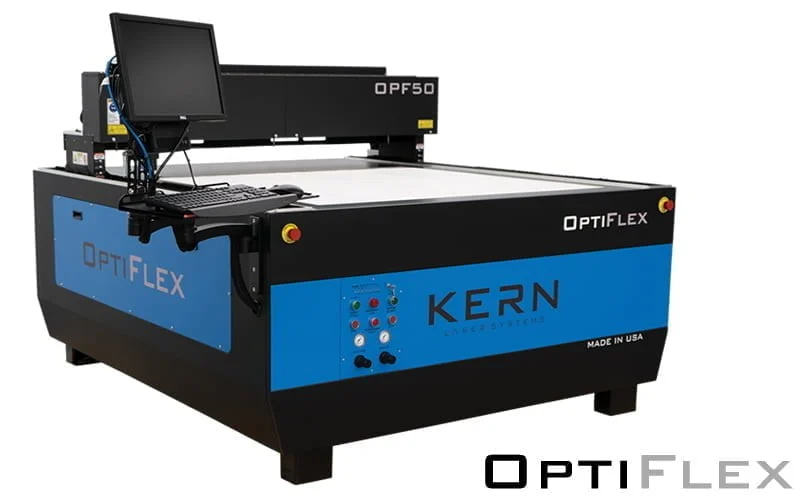
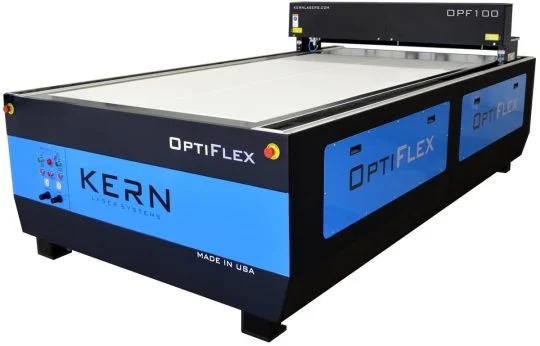
OptiFlex Platform
The ultimate open-bed production powerhouse. Designed for high-volume processors handling full 4x8 ft or 5x10 ft sheets of acrylic, wood, foam, and mild steel sheet goods.
Selecting enterprise-grade CO2 Laser Source Equipment requires evaluating more than peak wattage numbers listed on a specification sheet. For global manufacturing buyers, system reliability is directly governed by resonator gas purity, radio frequency (RF) discharge stability, optical cavity thermal management, and motion system rigidity.
Since 1982, Kern Laser Systems has engineered, welded, machined, and calibrated industrial CO2 laser equipment inside our factory in Wadena, Minnesota, USA. Unlike OEM assemblers who integrate third-party glass DC laser tubes with imported motion gantries, Kern designs and builds proprietary super-pulsed metal-channel RF CO2 laser sources ranging from 150W up to 800W.
Procurement directors and plant managers evaluating industrial CO2 laser source equipment must scrutinize beam quality factors ($M^2$), excitation methods, and thermal stability. Below is a structural analysis of why RF metal-channel technology dominates high-duty production environments.
Traditional Direct Current (DC) glass laser tubes rely on high-voltage electrical discharges across a glass gas column. While lower in initial cost, DC glass sources suffer from slow pulse response rates, thermal lensing distortions, rapid gas degradation, and short operational lifespans (typically 2,000 to 4,000 hours).
In contrast, Kern’s metal-channel RF-excited CO2 laser sources utilize radio frequency energy to excite the gas mixture ($CO_2-N_2-He$). This solid-state excitation yields ultra-fast modulation frequencies up to tens of kilohertz. Fast switching permits high-speed raster engraving without tailing and crisp vector cutting through dense polymers.
Super-pulsing is a technique where the RF power supply injects brief, intense bursts of energy into the plasma tube. A nominal 400-watt CO2 source can achieve instantaneous peak burst power approaching 1,200 watts. This intense pulse rapidly vaporizes material before heat can conduct into surrounding substrate walls, resulting in flame-polished acrylic edges, reduced dross on metal cuts, and near-zero charring on timber laminates.
Near-diffraction-limited TEM00 mode output guarantees a tight focal spot diameter, multiplying energy density ($W/cm^2$) at the cutting face for maximum cutting speed per watt.
Precision temperature feedback controls prevent resonator cavity length expansion, maintaining identical power output during 24/7 continuous operation.
Unlike disposable glass tubes, Kern RF CO2 metal sources are fully field-serviceable and can be evacuated, baked out, and re-gassed for indefinite production operational life.
The 10.6-micrometer infrared output is absorbed readily by organic polymers, wood, quartz, glass, rubbers, and coated metals, outperforming 1.06 μm fiber lasers on non-metallics.
Maximum continuous/pulsed output for heavy industrial material processing.
Heavy steel gantry motion calibrated with linear optical encoders.
Full warranty coverage engineered into every US-built CO2 source.
Over four decades of dedicated laser machine innovation and global support.
Explore our complete industrial machine suite. Each platform is built around our heavy-duty steel base, paired with optimized beam delivery optics, high-resolution KCAM control software, and customizable CO2 power source options.
The ultimate open-bed production powerhouse. Designed for high-volume processors handling full 4x8 ft or 5x10 ft sheets of acrylic, wood, foam, and mild steel sheet goods.
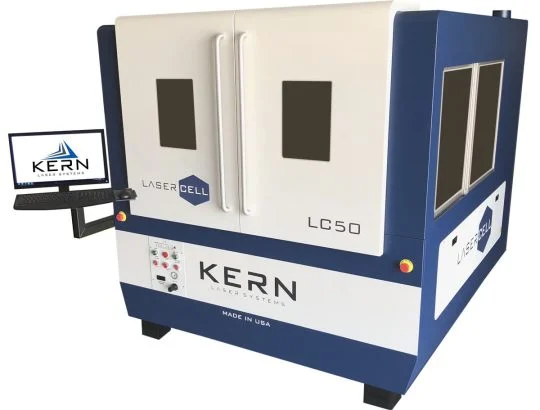
Fully enclosed Class 2 safety housing designed for high-density production environments, educational institutions, and safety-strict manufacturing plants.
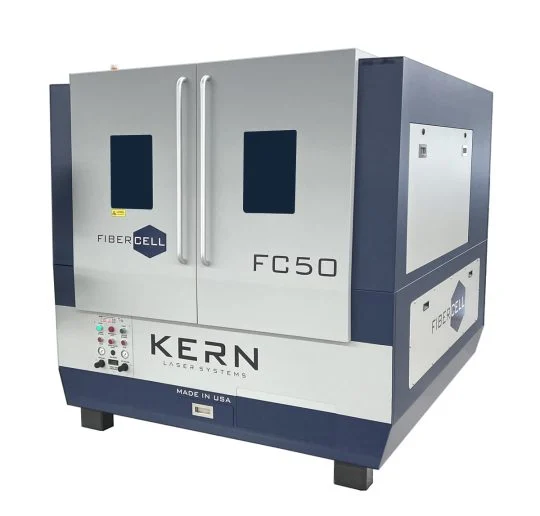
Engineered primarily for sheet metal fabrication, featuring high-power fiber optic sources or hybrid configurations for shops processing stainless steel, aluminum, and brass.
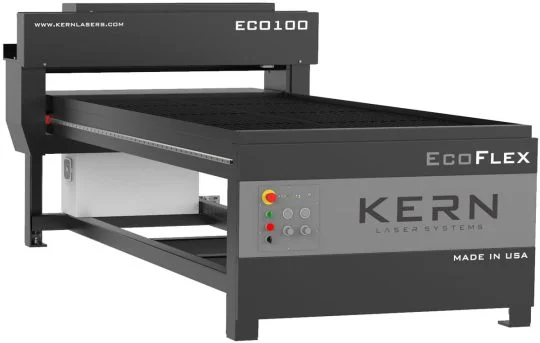
Combines a large-format work table with Kern's core CO2 laser source technology at an accessible capital outlay for expanding custom fab shops.
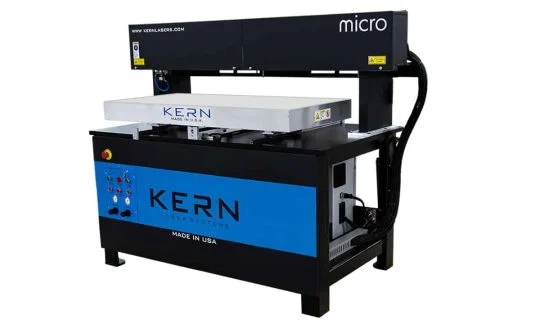
Small footprint work area with high-wattage CO2 laser capability. Ideal for medical device component cutting, tool prototyping, and precision parts.
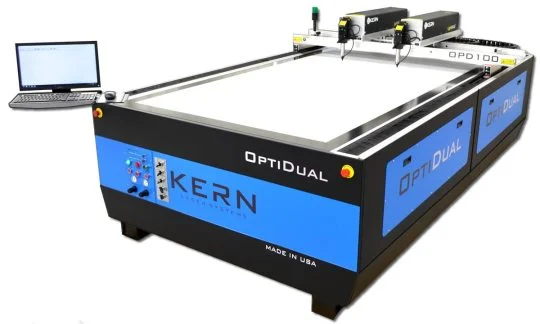
Features multi-head laser technology operating simultaneously on a single gantry, doubling or tripling production output without increasing floor space.
Compare laser source capacities, maximum material penetration, and functional software add-ons across the Kern product portfolio.
| Machine Platform | Available CO2 Power | Max Non-Metal Cut (Acrylic) | Mild Steel Metal Cutting | Motion System Type | Primary Target Industry |
|---|---|---|---|---|---|
| OptiFlex | 150W, 250W, 400W, 600W, 800W | Up to 1.5 in (38 mm) | Up to 1/8 in (with Oxygen assist) | Closed-loop High-Speed Servo | Signage, Packaging, Industrial Fab |
| LaserCELL | 150W, 250W, 400W, 600W | Up to 1.25 in (30 mm) | Up to 0.090 in steel | Class 2 Enclosed Servo System | Universities, Cleanroom, Defense |
| EcoFlex | 150W, 250W, 400W | Up to 1.0 in (25 mm) | Light sheet metal etching | Precision Rack & Pinion Servo | Woodworking, Architectural Models |
| Micro | 150W, 250W, 400W | Up to 1.0 in (25 mm) | Specialized thin gauge cut | High-Precision Compact Gantry | Electronics, Medical Tools, Gaskets |
| OptiDual | Dual 150W to Dual 400W | Up to 1.0 in (25 mm) dual cut | N/A (Focused on high speed non-metals) | Dual-Head Synchronized Motion | High-Volume Foam, Textile, POP |
As global supply chains realign around total cost of ownership (TCO) and rapid equipment serviceability, international enterprise buyers are shifting away from low-cost, unserviced optical machinery. Here are four dominant trends shaping industrial CO2 laser procurement.
B2B buyers are conducting lifecycle emissions and replacement cost audits. Importing disposable DC glass laser tubes every 12 to 18 months incurs recurring shipping costs, downtime, and alignment hassles. Metal RF CO2 sources, designed to be refurbished and re-gassed indefinitely, present a significantly lower 10-year capital footprint.
Procurement departments seek operational versatility. Instead of acquiring two separate machinery lines, demand is rising for hybrid gantries capable of mounting both a CO2 laser source (for acrylics, wood, plastics) and a Fiber laser head (for copper, brass, stainless steel) on a single unified frame.
Labor shortages across manufacturing hubs drive the requirement for automated vision alignment. Optics-integrated vision systems (such as Kern’s K-Vision) automatically detect printed fiducials, adjusting vector cut lines dynamically to compensate for material stretch or sheet misplacement.
Global manufacturers cannot afford weeks of machine shutdown waiting for overseas proprietary circuit board replacements. Purchasing US-built laser equipment backed by standard off-the-shelf industrial motion components ensures rapid spare-part delivery and minimal factory downtime.
The evolution of CO2 laser technology is advancing alongside smart factory automation, machine learning software, and energy-efficient optical delivery designs.
Modern CAD/CAM software suites, including Kern’s KCAM, are integrating adaptive nesting algorithms that automatically analyze material heat accumulation. By adjusting laser pulse frequency dynamically around tight geometry turns, the software prevents thermal warping and material burnout.
Laser cavity designs are continuously achieving higher wattages per meter of gas tube length. Advances in RF power module design allow 600W and 800W CO2 sources to fit onto standard machine gantries without requiring massive external optical bench setups.
Innovations in supersonic nozzle design reduce compressed air and gas consumption by up to 40%. Additionally, solid-state RF power units deliver higher wall-plug electrical efficiency, lowering power draw during high-volume production shifts.
Cloud-connected laser controllers monitor RF supply voltage, chiller fluid flow rates, optical temperature sensors, and tube pressure in real time, alerting maintenance managers to perform routine service before unplanned downtime occurs.
CO2 Laser Source Equipment remains the undisputed gold standard for non-metallic processing while offering versatile cutting capabilities for light-gauge metals.
Produces optical flame-polished edges up to 1.5 inch thick without secondary flame buffing or mechanical sanding.
High modulation rates deliver detailed 3D raster engraving on maple, walnut, MDF, and structural plywood sheet stock.
Non-contact beam cutting prevents foam compression or blade dragging on technical textiles, rubber, and dense packaging foams.
Comprehensive answers addressing common questions regarding CO2 laser source selection, maintenance, gas requirements, and total operational cost.
Glass Direct Current (DC) laser tubes utilize high-voltage electrodes inside a fragile glass envelope to excite carbon dioxide gas. They operate with lower pulse modulation speeds, have shorter operational lifespans (2,000–4,000 hours), and are generally considered disposable components. RF (Radio Frequency) metal-channel CO2 laser sources use all-metal aluminum or stainless steel plasma cavities excited by solid-state RF power supplies. They offer rapid pulsing frequencies (tens of kilohertz), superior beam quality ($M^2 \le 1.1$), longer lifespans (up to 40,000 operational hours before gas refresh), and are fully re-gassable and field-serviceable.
Selecting the optimal wattage depends on material density, thickness, and throughput target:
Yes. When equipped with Kern’s super-pulsed technology and an oxygen-assist gas assembly, a 400W to 800W CO2 laser source can cut carbon steel / mild steel up to 1/8 inch (3.2mm) thick and thin stainless steel. For facilities focused primarily on reflective non-ferrous metals (aluminum, brass, copper) in heavy gauges, Kern also manufactures dedicated Fiber laser systems like the FiberCELL.
Industrial RF metal CO2 laser sources require closed-loop distilled water chilling to maintain active gas cavity temperature stability within ±1°C. Power requirements typically range from 208V to 230V single-phase or three-phase power depending on source wattage and motion gantry power requirements. Kern provides comprehensive pre-installation utility specification guides tailored to international power standards.
Kern’s RF-excited metal CO2 laser sources are built to deliver tens of thousands of operating hours. Regular maintenance involves inspecting and cleaning external beam optics (focal lenses and silicon gold-coated turning mirrors), keeping chiller coolant pure, and inspecting air filters. After 5 to 7 years of continuous multi-shift operation, laser power may naturally decay as internal gas degrades; at this stage, the metal tube can be factory evacuated, re-gassed, and recalibrated at a fraction of the cost of a new laser source.
Kern Laser Systems ships equipment globally inside export-ready, heavy-duty wooden crates compliant with ISPM 15 standards. Support is delivered through factory-trained international distributors, direct remote computer diagnostics, high-definition video assistance, and expedited overseas spare part shipments.
Investing in industrial machinery is a long-term capital commitment. Kern Laser Systems provides the structural integrity, proprietary software control, and direct technical backing required to protect your ROI.
Heavy structural steel tubes are stress-relieved and precision-machined in-house, preventing bed twisting or optical misalignments over decades of heavy production handling.
In-house developed KCAM control software provides intuitive vector positioning, raster engraving parameter libraries, nesting controls, and direct CAD file import compatibility.
Camera-assisted vision registration locates printed targets on pre-printed sheet goods, automatically compensating for stretch and rotation to guarantee perfect contour cuts.
Send your raw sheet stock, synthetic fabrics, wood, or acrylic samples directly to our application laboratory in Minnesota. Our engineers will perform cut tests using specified CO2 laser source equipment, document processing speeds, and return the finished cut samples alongside a detailed feasibility report.
Speak directly with our technical application specialists today to select the optimal laser source power, table footprint, and automation add-ons for your manufacturing goals.