Direct factory supply of high-precision mini fiber, UV, MOPA, and handheld laser marking machines engineered for industrial marking, deep engraving, and color annealing.
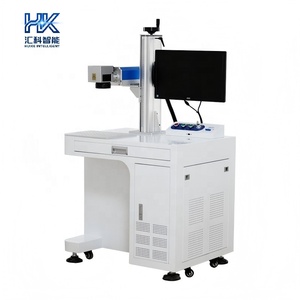
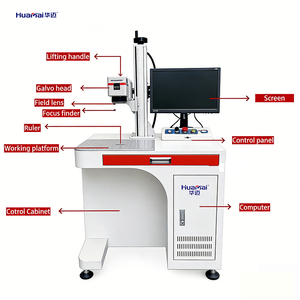
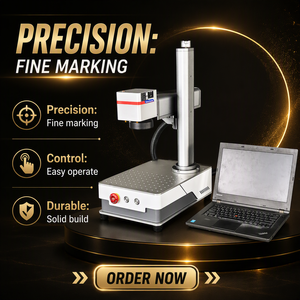
An in-depth evaluation of optomechanical miniaturization, thermal dynamics, optical fiber efficiency, and signal transmission standards in modern desktop laser platforms.
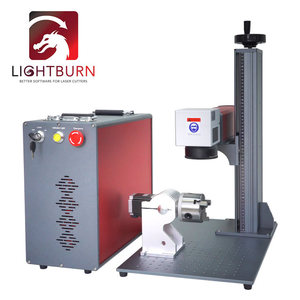
Over the past decade, the global manufacturing landscape has witnessed a rapid transition from bulky, water-cooled, multi-cabinet laser markers to modular, air-cooled, ultra-compact mini laser systems. China's industrial manufacturing ecosystem—anchored in Wuhan (Optics Valley), Shenzhen, and Jinan—has spearheaded this architectural revolution by integrating ytterbium-doped fiber laser sources, solid-state UV crystals, and high-frequency galvo scanners into chassis footprints smaller than a standard desktop computer tower.
Modern mini laser markers utilize advanced optical path design where beam expanders, isolators, and galvo scanning mirrors are integrated directly onto a single zero-thermal-expansion optical bench. This eliminates focal drift caused by ambient temperature fluctuations during extended 24/7 production runs. Furthermore, power supply units (PSUs) have transitioned to high-efficiency switching architectures (DC 24V/48V), achieving electrical-to-optical conversion efficiencies exceeding 30%, compared to legacy CO2 or lamp-pumped YAG systems operating below 5% efficiency.
Miniature fiber lasers engineered by top China suppliers consistently achieve an $M^2 < 1.3$, resulting in a diffraction-limited focal spot diameter under 20 microns when paired with 160mm F-theta lenses. This immense energy density enables ultra-fine thermal ablation and zero-heat-affected-zone (HAZ) annealing on delicate substrates.
While standard Q-switched fiber lasers operate at fixed pulse durations (approx. 100ns), Master Oscillator Power Amplifier (MOPA) fiber sources (such as the JPT M7 series) allow independent adjustment of pulse frequency (1kHz to 4000kHz) and pulse duration (2ns to 500ns). This flexibility allows clean anodized aluminum stripping, black marking on stainless steel, and vibrant color engraving on titanium alloys without warping thin gauge sheet metals.
Ultraviolet (UV) mini lasers utilize third-harmonic generation (THG) to convert 1064nm infrared light to a 355nm short wavelength. Because UV photons possess sufficient quantum energy to break molecular bonds directly (photodecomposition), they mark thermo-sensitive polymers, medical-grade HDPE, glass bottles, and silicon wafers with absolute zero thermal damage or perimeter charring.
China's Tier-1 mini laser systems incorporate dual-axis digital galvos (e.g., Sino-Galvo SG7110 or RC1001 series) featuring high-precision optical encoders. Operating at closed-loop response speeds under 0.2ms, these galvos process up to 1,000 characters per second while maintaining positional repeatability of ±0.001mm across standard F-theta field sizes (110x110mm to 300x300mm).
Technical baseline comparison across mini fiber, MOPA, UV, and handheld portable configuration options to assist industrial buyers in optical selection.
| Laser Platform Type | Wavelength & Source | Cooling Mode | Primary Substrates | Marking Speed | Key Advantage |
|---|---|---|---|---|---|
| Standard Desktop Mini Fiber | 1064nm Raycus/MAX | Air Cooling | Carbon Steel, Stainless, Brass, ABS | ≤ 8,000 mm/s | High Cost Efficiency |
| JPT MOPA Color Fiber | 1064nm JPT M7 (2ns–500ns) | Air Cooling | Titanium, Stainless, Anodized Al, Plastics | ≤ 12,000 mm/s | Color & Black Annealing |
| High-Power Desktop Fiber | 1064nm Raycus/JPT 100W–300W | Air/Water Hybrid | Thick Metal Deep Engraving, Sheet Cutting | ≤ 10,000 mm/s | Deep Depth Ablation |
| Desktop UV Cold Laser | 355nm Solid-State DPSS | Air Cooling (Integrated) | Glass, Cosmetics Packaging, PCB, PET | ≤ 7,000 mm/s | Zero Thermal Damage |
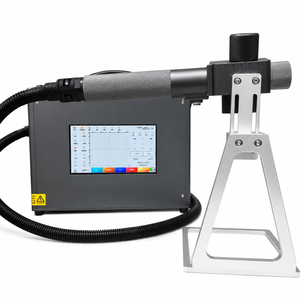
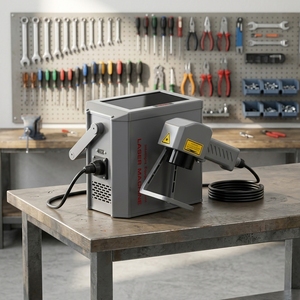
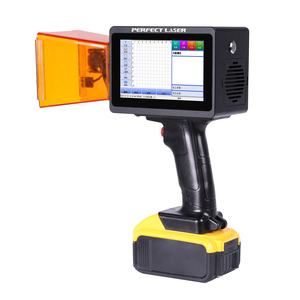
| Battery Handheld Mobile | 1064nm Pulsed Fiber | Forced Air | Heavy Castings, Structural Steel, Pipes | ≤ 6,000 mm/s | 100% Outdoor Mobility |
Critical market shifts and optical innovations transforming the global sourcing strategy for industrial laser machinery buyers.
Historically, laser sources exceeding 100W required external 3U water chillers, increasing overall machine weight to over 120kg. Next-generation Chinese laser source manufacturers (Raycus, JPT, MAX) have developed multi-channel micro-channel cooling structures and heat-pipe radiator assemblies. This enables 100W–200W fiber sources to operate with forced-air cooling in bench-top chassis weighing under 35kg.
For international buyers, this dramatically reduces freight costs (both air courier and sea LCL) while providing deep engraving, metal slicing, and high-speed industrial part serialization capabilities previously restricted to heavy-duty floor-standing units.
Manual focus height adjustment via red-dot alignment is being replaced by coaxial CCD cameras and time-of-flight (ToF) distance sensors integrated into the laser head. Systems equipped with EZCAD3 or modern 64-bit control software automatically detect part orientation, surface curvature, and height offsets (up to ±40mm).
The vision system aligns vector graphics to uneven or tilted components in under 50 milliseconds, eliminating the requirement for expensive physical jigs, clamping fixtures, or manual part positioning on assembly lines.
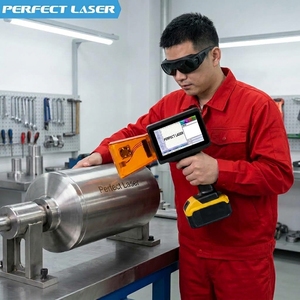
Field maintenance in oil & gas, shipbuilding, rail infrastructure, and structural steel erection demands permanent marking directly on installed infrastructure. The latest battery-powered handheld mini lasers utilize automotive-grade lithium iron phosphate (LiFePO4) battery packs delivering 24V/30Ah power.
Combined with lightweight optical gun handles (weighing under 1.25kg), field operators can perform over 8 hours of continuous wireless marking, generating 2D DataMatrix codes, VIN numbers, and barcode serialization in harsh outdoor environments.
As regulatory enforcement tightens across North America (FDA/CDRH) and Europe (CE Machinery Directive 2006/42/EC), Chinese manufacturers are delivering fully enclosed mini laser systems with safety interlocks, OD6+ protective viewing windows, and integrated active fume extraction units.
These mini Class-1 laser platforms allow safe deployment in educational environments, retail jewelry shops, and dense production floors without requiring operators to wear specialized laser safety goggles.
Why leading global brands and industrial distributors source mini laser machinery directly from our specialized China manufacturing facility.
Every mini laser system undergoes a rigorous 72-hour continuous burn-in aging test. We utilize Ophir power meters to verify optical output stability (<±1.5% power variance over 24 hrs) and double-interferometers to validate optical axis alignment before factory exit.
We provide full-service white-label manufacturing for global equipment brands. Customization includes powder-coated chassis color matching, custom logo laser-etching, customized control software GUIs, localized wiring harnesses, and custom packaging designs.
Located in core industrial transportation hubs with direct access to Qingdao, Shanghai, and Shenzhen ports. Standard mini laser configurations are maintained in ready-to-ship inventory, enabling 3-day fast dispatch and international air freight delivery within 7 business days.
Direct technical and logistical answers to standard buyer inquiries regarding machine selection, maintenance, customs compliance, and optical longevity.
Get instant access to our 2026 Mini Laser Product Catalog, optical configuration charts, factory-direct price list, and sample testing reports.