ISO 9001:2015 & CE Certified OEM Exporter

Top China Laser Equipment Manufacturer & Exporter

Next-Generation Fiber, MOPA, CO2 & UV Industrial Laser Systems Engineering | Precision Photonics Solutions for Global Smart Manufacturing

40+
Years Photonics R&D
100,000h
Laser MTBF Rating
±0.001mm
Repetition Accuracy
80+
Global Export Countries

Flagship Industrial Laser Systems Portfolio

Engineered with premium laser engines (JPT, Raycus, MAX), high-speed digital galvo scanners, and intelligent CNC software for high-duty production environments.
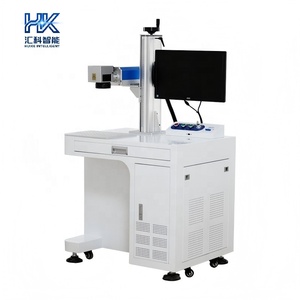
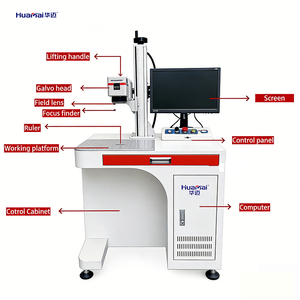
High Power Fiber Laser Marking Machine
Industrial Fiber Series

High-Power Fiber Laser Marking Machine (100W-300W)

  • Source Options: JPT / Raycus / MAX Fiber
  • Power Spectrum: 20W, 30W, 50W, 70W, 100W to 300W
  • Substrates: Metals, Hard Plastics, Alloys
  • Beam Quality: M² < 1.5 Sub-Micron Precision
Get Catalog
Portable Auto Focus MOPA Fiber Color Laser Engraver
Color Engraving & MOPA

Portable Auto-Focus JPT MOPA Fiber Color Laser Marker

  • Pulse Width: 2ns - 500ns Adjustable
  • Power Output: 20W / 30W MOPA Architecture
  • Feature: Stainless Steel Color & Anodized Black
  • Focusing: Automated Sensor Auto-Focusing
Get Catalog
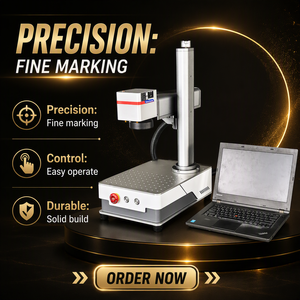
Desktop Mini Fiber Laser Marking Machine
Compact Benchtop

Desktop Mini Compact 30W Fiber Laser Engraver

  • Footprint: Ultra-Compact Lightweight Design
  • Application: Hardware, Tools, Jewelry, Stainless
  • Cooling: 100% Maintenance-Free Air Cooling
  • Lifespan: 100,000 Hours Diode Operation
Get Catalog
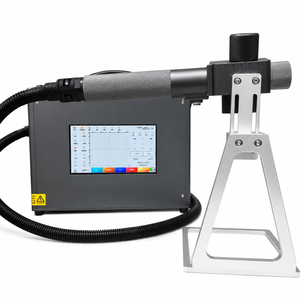
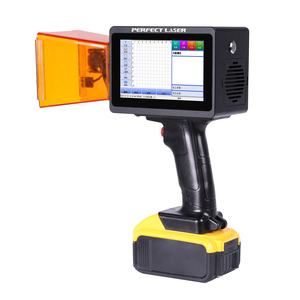
Handheld Mobile Portable Mini Laser Marker
Mobile Industrial

2026 Handheld Mobile Portable Mini Laser Marking Machine

  • Power Range: 20W / 30W / 50W Fiber Module
  • Operation: Handheld Ergonomic Touch Trigger
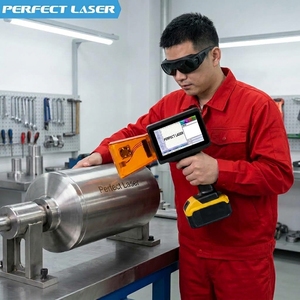
  • Ideal For: Heavy Machinery Parts & On-Site Coding
  • Control: Touchscreen Embedded Controller
Get Catalog
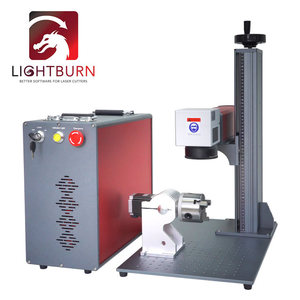
100W JPT MOPA Bench-Top Laser Engraving System with Rotary
Heavy-Duty Bench-Top

100W JPT M7 MOPA Precision System + 80mm Rotary

  • Marking Area: 300x300mm Field Lens Included
  • Rotary Module: 80mm Chuck Axis for Cylindrical Work
  • Compatibility: DXF, PLT, AI, LightBurn & EzCad
  • Cooling System: High-CFM Heavy Duty Air Cooling
Get Catalog
Small Desktop UV Laser Engraving Machine
Cold Light UV Laser

Small Desktop Air-Cooled UV Laser Marking Machine

  • Wavelength: 355nm Ultra-Violet Cold Processing
  • Substrates: Cosmetic Glass, HDPE, PET, Ceramics
  • Thermal Effect: Near Zero Heat-Affected Zone (HAZ)
  • Precision: Micro-Scale Fine Coding & QR Codes
Get Catalog
Portable Battery Powered Industrial Laser Marker
Battery-Powered Field Unit

Industrial Rechargeable Battery Handheld Laser Marker

  • Power Supply: High-Capacity Lithium Battery Pack
  • Mobility: 100% Cordless Field Operation
  • Applications: Structural Steel, Pipelines, Outdoor Logistics
  • Durability: IP54 Industrial Ruggedized Frame
Get Catalog
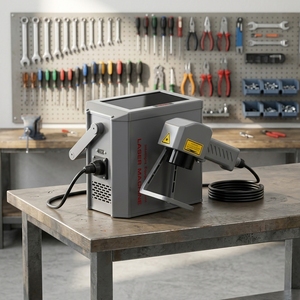
Multi-Material Portable Handheld Laser Coding Machine
Multi-Material Coding

Multi-Material Portable Handheld Laser Engraving System

  • Materials: Metal, Wood, Leather, Plastics, Foams
  • Laser Engine: Hybrid CO2 / Fiber Portable Optics
  • Integration: Barcode/QR Code Generator Onboard
  • Duty Cycle: 24/7 Industrial Production Ready
Get Catalog

Executive Technical Blueprint: Optical Sourcing & Industrial Laser Paradigms

An authoritative analysis of optical wave dynamics, beam quality metrics, and resonator selections for enterprise-grade material processing.

Fiber vs. MOPA vs. UV vs. CO2 Optics

Selecting the optimal laser wavelength and pulse characteristics dictates modern manufacturing efficiency, edge quality, and thermal stress on substrates:

  • Ytterbium Fiber Lasers (1064nm): The benchmark for metallic processing. Features exceptional wall-plug efficiency (>30%) and high peak power for stainless steel, carbon steel, brass, and aluminum.
  • MOPA Fiber Lasers (Master Oscillator Power Amplifier): Offers independent pulse duration adjustment (2ns to 500ns). Enables precise heat control, preventing corrosion on medical-grade stainless steel and allowing vibrant color marking on titanium and black marking on anodized aluminum.
  • UV Cold Lasers (355nm): Utilizing third-harmonic generation (THG), UV lasers break molecular bonds directly without thermal damage. Essential for delicate electronics, glass, and pharmaceutical packaging.
  • CO2 RF Laser Tubes (10.6µm): Superior photon absorption in organic materials including hardwoods, acrylics, leather, glass, and technical textiles.

Beam Quality Metrics & Galvo Dynamics

Industrial photonics performance relies on beam propagation metrics and optical steering speeds:

  • Beam Parameter Product (BPP) & M² Factors: Premium Chinese fiber systems maintain M² < 1.3 to 1.5, ensuring tight focal spots, higher power density, and reduced kerf widths.
  • High-Speed Digital Scanheads: Dual-axis galvanometer mirrors with low-drift optical encoders deliver processing speeds up to 12,000 mm/s with sub-micron repeatability.
  • Telecentric F-Theta Field Lenses: Custom-coated fused silica lenses maintain perpendicular beam incidence across the entire 300x300mm field, eliminating edge distortion.
Technology Platform Wavelength Substrates Handled Pulse Width Control Expected Engine Life Cooling Method
Q-Switched Fiber (Raycus/MAX) 1064nm Metals, Opaque Plastics Fixed (90 - 120ns) 100,000 Hours Air Cooled
JPT MOPA M7 Series 1064nm Metals, Anodized Al, Sensitive Polymers Tunable (2 - 500ns) 100,000 Hours Air Cooled
DPSS UV Cold Laser 355nm Glass, HDPE, Silicon, Ceramics Ultra-Short (<15ns) 20,000 - 30,000 Hours Water Chilled / Advanced Air
RF Metal Tube CO2 10.6µm Acrylic, Wood, Fabrics, Foams Continuous / Pulsed CW 40,000 Hours (Refillable) Air Cooled / Chilled

Industrial Sourcing Guide: Procurement Trends & Strategic TCO Optimization

Key procurement factors for international machinery importers, OEM distributors, and high-volume industrial end-users.

1. Total Cost of Ownership (TCO) Shift

Global manufacturing hubs are replacing traditional mechanical CNC engravers and inkjets with air-cooled fiber laser systems due to lower operational overhead:

  • Zero Consumable Overhead: Eliminates continuous expenditure on inks, chemical solvents, routing bits, and specialized gas fluids.
  • Wall-Plug Electrical Efficiency: Solid-state fiber lasers operate at >30% electro-optical efficiency, cutting electrical consumption by up to 70% compared to legacy lamp-pumped systems.
  • Near-Zero Maintenance: Solid-state architecture eliminates mirror alignment routines and mechanical wear items.

2. Rise of Mobile & Handheld Form Factors

Factory workflows are moving away from centralized processing tables toward point-of-use handheld marking tools:

  • On-Site Traceability: Heavy equipment components, structural steel beams, and installed pipework can be marked directly in the field without moving heavy parts.
  • Battery-Powered Autonomy: High-density lithium battery modules provide up to 6-8 hours of continuous cordless field operation for remote logistics yards.
  • Compact Optical Heads: Ergonomic handheld optical heads weigh less than 1.2kg while delivering full industrial power output up to 50W.

Technology Horizon (2026–2030): Next-Gen Laser Physics & Automation

A look at upcoming optical engineering developments, AI vision integration, and smart factory connectivity.

1. AI-Powered Machine Vision & Smart Alignment

Next-generation systems integrate coaxial CCD cameras with deep-learning vision algorithms directly into the optical path:

  • 360° Automatic Part Recognition: Objects placed randomly on the conveyor belt are automatically detected, oriented, and processed without mechanical fixturing.
  • Real-Time Depth Mapping: Automated Z-axis adjustments compensate for surface irregularities, warped sheets, or complex 3D contours on the fly.
  • Closed-Loop Quality Verification: Onboard vision systems verify 2D Data Matrix legibility against ISO/IEC 15415 standards immediately after processing.

2. High-Peak Kilowatt Pulsed Fiber Systems

The boundary between low-power marking and high-power macro machining continues to blur:

  • Sub-Nanosecond Picosecond Engines: Ultra-short pulse durations minimize thermal diffusion, enabling burr-free micro-drilling and precise layer removal.
  • Multi-kW Fiber Deep Engraving: High peak-power pulsed fiber systems enable rapid 3D mold cavity engraving and heavy steel serial numbering at depth.
  • Green & Deep-UV Laser Maturation: 532nm Green and 266nm Deep-UV sources are becoming more accessible, unlocking ultra-precise processing of silicon wafers and solar cells.

Enterprise Engineering Integrity & Manufacturing Authority

Combining world-class optical engineering, rigorous quality control, and robust global support to power industrial supply chains.

100% Optical & Stress Testing

Every machine undergoes a strict 72-hour continuous full-power burn-in protocol, beam profile analyzer scanning, and interferometric laser alignment before export clearance.

Tier-1 Global Component Integration

We source optics and electronics from industry leaders: JPT, Raycus, and MAX laser engines; MeanWell power units; Schneider electricals; and genuine Field Optics lenses.

Global Export Compliance & Support

Fully compliant with CE, FDA CDRH laser safety standards, and ISO 9001 regulations. Comprehensive English technical manuals, SDK documentation, and 24/7 remote diagnostics support.

B2B Industrial Laser Procurement FAQ

Technical guidance and answers to common questions from international buyers, procurement officers, and plant engineers.

What is the functional difference between Raycus, MAX, and JPT MOPA fiber laser engines?
Raycus and MAX utilize Q-switched technology with fixed pulse widths (approx. 90-120ns), making them robust and cost-effective workhorses for general metal engraving, carbon steel marking, and deep cutting. JPT MOPA (Master Oscillator Power Amplifier) engines allow operators to independently adjust pulse frequency and pulse duration (2ns to 500ns). This precise pulse tuning enables color marking on titanium, high-contrast black marking on anodized aluminum, and delicate marking on heat-sensitive polymers without scorching.
How does air cooling compare to liquid water chilling for industrial fiber & UV lasers?
Fiber lasers from 20W up to 100W/200W feature high wall-plug efficiency (>30%) and generate minimal excess heat, allowing 100% air-cooled operation via integrated heatsinks and internal fans. This design eliminates liquid chillers, reduces system size, avoids water maintenance, and cuts power consumption. High-power UV systems or continuous multi-kilowatt fiber systems, by contrast, use external closed-loop water chillers to keep optical crystals and laser diodes within strict temperature margins (±0.5°C).
What vector graphics formats and industrial software packages are supported?
Our CNC control systems natively accept standard 2D and 3D vector files, including DXF, PLT, AI, SVG, DST, BMP, JPG, and NC code. Software options include EzCad2, EzCad3 (for 3D dynamic focus marking), LightBurn, and custom SDK packages for seamless integration into automated PLC production lines.
What safety ratings apply, and how are machines prepared for international export?
Open-frame fiber markers operate as Class 4 laser devices, requiring operators to wear safety goggles rated for OD6+ at 1064nm. Fully enclosed benchtop platforms (like the LaserCELL or UV units) feature certified protective viewports and door interlocks to meet Class 2 safety standards for open factory floors. All export machinery is packed in vacuum-sealed moisture barrier bags and heavy-duty, fumigation-free ISPM-15 plywood crates.
What is the typical operating lifespan and replacement schedule for critical optical components?
Solid-state Ytterbium fiber laser diodes have a Mean Time Between Failures (MTBF) rating of 100,000 operational hours—translating to over 10 years of multi-shift industrial use. Galvanometer scanhead mirrors and F-Theta field lenses are protected by anti-reflective coatings and optical protective windows. Under clean operating conditions with adequate fume extraction, optical elements require zero major replacement for years.

Request Technical Specifications & Factory Pricing

Connect directly with our senior application engineers to receive custom material sample reports, complete CAD integration drawings, and OEM catalog options.