Engineered for permanent part traceability, metal engraving, and high-speed marking across automotive, aerospace, electronics, and precision hardware manufacturing.
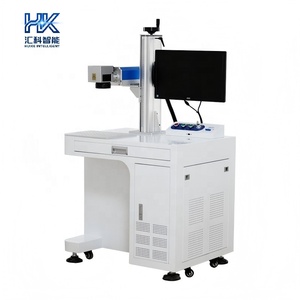
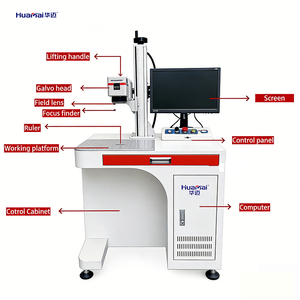
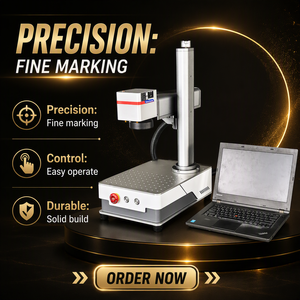
Closed-loop servo precision engineered for micron-level positional accuracy across continuous operation shifts.
Mean Time Between Failures for state-of-the-art fiber optics and solid-state laser diode pumping architectures.
Factory direct warranty coverage on proprietary super-pulsed CO2 and tier-1 fiber laser optical engines.
Over four decades of continuous design, machine welding, and optical integration leadership based in Wadena, MN, USA.
In modern manufacturing ecosystems, direct part marking (DPM) and high-speed structural tracking have evolved from peripheral compliance requirements into core pillars of quality assurance, supply chain security, and automated lifecycle management. The global transition toward Industry 4.0 demands that every critical component—from aerospace titanium fasteners and automotive drivetrain gears to medical-grade surgical tools—carries high-contrast, indelible 2D DataMatrix codes, serialized alphanumeric text, and vector graphics.
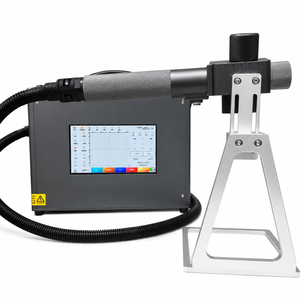
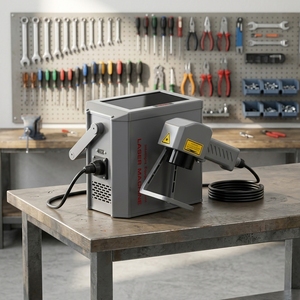
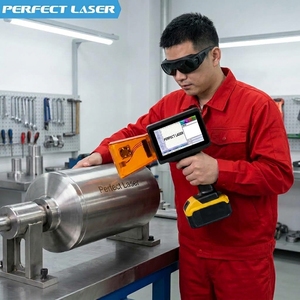
Historically, industrial laser marking was confined to massive, stationary Class 1 workstations or dedicated inline conveyor systems. However, the rapid advancement of solid-state photonics, master oscillator power amplifier (MOPA) fiber engines, and lithium-ion power storage has birthed a revolutionary category: High-Performance Handheld & Portable Laser Marking Systems. These lightweight, mobile units unleash sub-micron photonics directly onto heavy machinery, structural beams, pipelines, and oversized molds without requiring complex material transport mechanisms.
Information Gain Key Takeaway: Modern handheld laser markers eliminate up to 70% of material handling overhead by taking the laser beam directly to the workpiece. By replacing consumable-heavy inkjets and mechanical pin markers, fiber handheld systems achieve zero chemical waste, zero consumable cost, and permanent thermal oxidation depth control.
As manufacturers evaluate global sourcing options, identifying the top handheld laser manufacturers and exporters requires analyzing beam quality optics (M² factor), galvo scanning mirror dynamics, power stability tolerances, and thermal mitigation design. This whitepaper provides procurement directors, industrial engineers, and factory managers with an authoritative engineering benchmark and comprehensive procurement framework.
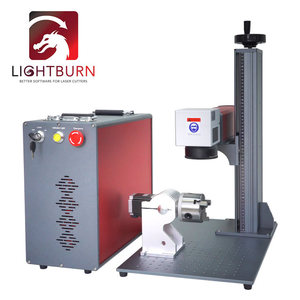
Combining super-pulsed CO2 and ytterbium fiber laser optical engines on unified gantry and handheld platforms. Operators can seamlessly transition between non-metallic substrates (acrylic, wood, foam, leather) and reflective metallic alloys (stainless steel, brass, copper, aluminum) without secondary fixturing.
Built upon heavy-duty stress-relieved welded steel frames and precision-ground linear motion guides. Closed-loop digital servomotors ensure sub-thousandth-of-an-inch positional accuracy even during 24/7 continuous high-speed raster and vector engraving runs.
Integrated high-resolution machine vision software automatically detects fiducial registration marks, compensating for workpiece rotation, skew, and material expansion. Cuts and engraves preprinted graphics with zero reliance on manual mechanical alignment jigs.
Proprietary CO2 laser sources engineered and serviced in-house carry an industry-leading 3-year factory warranty. High peak-power pulse modulation drastically minimizes heat-affected zones (HAZ), delivering razor-sharp edge polish on acrylics and crisp detail on hardwood.
Native enterprise laser operating suite featuring dynamic nesting algorithms, automated material speed/power parameter libraries, multi-head synchronization, and real-time diagnostic monitoring for maximum production yield.
The table below provides a rigorous technical comparison of leading global laser equipment manufacturers, focusing on core laser optical source tech, structural engineering, optical parameters, and industrial reliability.
| Manufacturer / Brand | Primary Optical Sources | Max Power Range | Beam Quality (M²) | Repeatability | Key Strengths & Market Position |
|---|---|---|---|---|---|
| Kern Laser Systems / DYC | Fiber / MOPA / Super-Pulsed CO2 | 20W – 800W CO2 / 3kW Fiber | M² < 1.2 | ±0.001" (±0.025mm) | US engineering heritage (1982), 3-yr CO2 warranty, dual-source hybrid gantries, portable fiber markers. |
| TRUMPF Group | Disk / Fiber / CO2 / Green | 20W – 10kW+ | M² < 1.1 | ±0.003mm | Global tier-1 premium industrial automation, heavy automotive integration, high capital expenditure. |
| IPG Photonics | Ytterbium Fiber / Diode | 20W – 120kW | M² < 1.1 | Integrated OEM | World leader in fiber laser source component manufacturing and high-power industrial cutting engines. |
| FOBA (Danaher) | Fiber / UV / CO2 | 10W – 100W | M² < 1.3 | Vision-Guided | Specialized vision-assisted precision laser marking systems for medical device and pharmaceutical serialization. |
| Trotec Laser | CO2 / Fiber Dual-Source | 20W – 120W | M² < 1.3 | ±0.015mm | Premium desktop and flatbed laser engraving units for commercial signage and trophy fabrication. |
| Han's Laser | Fiber / UV / CO2 / YAG | 20W – 20kW | M² < 1.4 | ±0.01mm | Massive Asian OEM production capacity spanning handheld laser welders, markers, and sheet cutters. |
| Gravotech | Fiber / Hybrid / Green / CO2 | 10W – 80W | M² < 1.3 | ±0.02mm | Permanent mechanical and laser marking solutions focused on traceability and jewelry engraving. |
| Telesis Technologies | Fiber / EV40 / UV / CO2 | 10W – 100W | M² < 1.2 | Robust Industrial | Pioneer in heavy-duty pin stamping and high-speed industrial optical laser coding for automotive VIN marking. |
| Keyence Corporation | Hybrid 3-Axis Fiber / UV / CO2 | 13W – 50W | 3-Axis Dynamic Focus | Integrated Vision | Proprietary 3-axis dynamic focal depth control with built-in inspection sensors for inline assembly automation. |
| Perfect Laser / Raycus Integration | Fiber / MOPA / UV / CO2 | 20W – 300W | M² < 1.3 | ±0.005mm | Export-driven versatile handheld and benchtop markers offering highly competitive performance-to-cost ratios. |
Selecting the correct optical source wavelength and pulse architecture dictates part processing quality, edge finish, processing speed, and thermal distortion risk. Below is an engineering breakdown of the four primary laser engines deployed in handheld and industrial machinery:
Operating Mechanism: Solid-state ytterbium-doped optical fiber pumped by semiconductor diodes. Emits at a fundamental wavelength of 1064nm.
Best Material Compatibility: Carbon steel, stainless steel, aluminum, brass, copper, titanium, and high-density ABS plastics.
Key Advantages: High wall-plug efficiency (>30%), zero optical maintenance, maintenance-free 100,000-hour diode lifespan, and aggressive material removal rates for deep metal engraving.
Operating Mechanism: Independent control of pulse duration (1ns to 500ns) and pulse repetition rate (1kHz to 4000kHz) via seed laser modulation.
Best Material Compatibility: Anodized aluminum (black marking), stainless steel (vibrant oxide color annealing), sensitive thin metal foils, and mixed polymers.
Key Advantages: Eliminates substrate burning, precise heat input control, high-frequency micro-machining, and rich black marking on anodized aluminum without surface oxidation destruction.
Operating Mechanism: Third-harmonic generation (THG) converting 1064nm fundamental laser light into 355nm ultraviolet radiation.
Best Material Compatibility: Heat-sensitive cosmetic packaging, medical-grade HDPE/PVC tubing, white silicone, glass, and delicate electronic PCBs.
Key Advantages: "Cold processing" photochemical breaking of molecular bonds rather than thermal melting. Zero thermal damage, ultra-fine spot size (<15 microns), and flawless micro-coding.
Operating Mechanism: Radio-frequency excited carbon dioxide gas mixture emitting in the far-infrared spectrum (10.6 micrometers).
Best Material Compatibility: Organic non-metals: cast acrylic, wood, MDF, leather, rubber, glass, stone, paper, and open-cell foams.
Key Advantages: High absorption rates in non-metallic molecular structures, delivering flame-polished acrylic edge cuts and clean raster engraving across wide table surfaces.
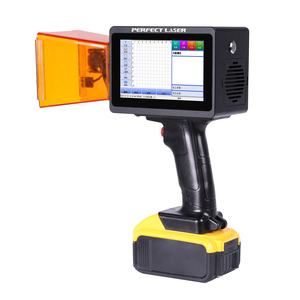
The market for handheld laser markers is moving rapidly toward fully autonomous, high-capacity lithium-ion powered units. Industrial field technicians working in shipyards, oil refineries, and structural steel assembly sites now utilize 24V/48V rechargeable handheld fiber markers capable of 6 to 8 hours of continuous marking without tethering to external power grids or air compressors.
Next-generation handheld units incorporate miniaturized LiDAR sensor arrays and high-speed focal displacement galvanometers. When an operator places the handheld cone against an uneven, curved, or inclined casting surface, the system calculates surface topography in real-time (<5 milliseconds) and dynamically adjusts the focal length to guarantee razor-sharp focus across 3D contours without manual height gauge adjustments.
With the global expansion of electric vehicle (EV) battery manufacturing, processing highly reflective pure copper busbars and hairpins presents optical reflection challenges for standard 1064nm fiber lasers. Emerging handheld and compact marking heads are integrating green and blue diode laser sources, which exhibit up to 8x higher absorption in copper, enabling spatter-free micro-welding and high-contrast identification coding.
Tightening global environmental ESG regulations (such as EU REACH and RoHS) are accelerating the phase-out of solvent-based continuous inkjet (CIJ) printers and hazardous chemical acid etching. Handheld laser markers offer a direct, zero-consumable alternative that eliminates volatile organic compound (VOC) emissions, ink cartridge disposal costs, and periodic printhead clogging downtime.