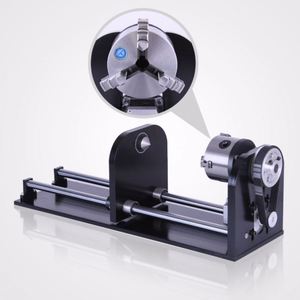
Engineering Whitepaper: Rotary Axis Kinematics & Motion Control Integration
A technical guide for machine tool builders, CNC integrators, and procurement directors evaluating 4th and 5th axis rotary platforms for high-throughput manufacturing.
In modern computer numerical control (CNC) milling, vertical machining centers (VMC), and high-precision laser processing systems, the rotary axis (commonly designated as the A, B, or C axis) represents the critical link between multi-axis kinematic freedom and structural rigidity. As global industrial manufacturing shifts toward complex 5-axis surface machining and ultra-precise cylindrical laser marking, selecting an OEM/ODM rotary axis supplier requires deep technical scrutiny of gear transmission mechanics, angular position feedback systems, and dynamic braking mechanisms.
Key Technical Takeaway: Zero-Backlash Gearing vs. Traditional Worm Drives
While traditional worm gear rotary tables suffer from thermal expansion friction and mechanical wear that degrades arc-second positioning over time, modern OEM strain-wave (harmonic) and planetary rotary axes maintain zero backlash (< 10 arcsec torsional lost motion) over millions of continuous duty cycles.
1. Kinematic Architectures in OEM Rotary Mechanisms
The core mechanical design of a rotary axis dictates its dynamic response, torque density, and operational lifespan under heavy radial and axial loading. As an established OEM/ODM manufacturer, our engineering team designs and customizes three primary drive architectures:
Zero-Backlash Planetary Units
Utilizes multi-stage hardened sun and planet gear sets to deliver exceptional torsional stiffness, high input speed capacity, and compact radial footprints for VMC 4th axis applications.
Direct-Drive Rotary (DDR) Axes
Eliminates mechanical gearing entirely by integrating high-torque permanent magnet synchronous motors (PMSM), achieving instantaneous dynamic response and infinite angular resolution.
Harmonic Strain-Wave Assemblies
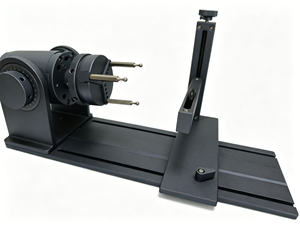
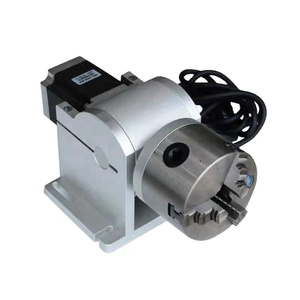
Engineered for high gear ratios in lightweight aluminum structures, widely used in fiber laser marking jigs, 3D laser engraving, and micro-jewelry rotation mechanisms.
2. Technical Specifications Matrix: Standard vs. Custom OEM Configurations
To assist procurement managers and machinery designers in selecting the optimal rotary axis platform, the following comparison matrix outlines standard performance thresholds across our production lines:
| Performance Parameter |
Light-Duty Laser Fixture |
Industrial CNC Router A-Axis |
VMC Heavy-Duty 4th Axis |
| Indexing Accuracy |
± 20 arcsec |
± 10 arcsec |
≤ 5 arcsec |
| Repeatability |
± 5 arcsec |
± 3 arcsec |
± 1.5 arcsec |
| Clamping Mechanism |
Manual / Spring Collet |
Pneumatic Brake (0.6 MPa) |
Hydraulic Brake (3.5 MPa) |
| Max Spindle Speed |
100 RPM |
80 RPM |
45 RPM |
| Spindle Bore Diameter |
Ø 15mm – Ø 35mm |
Ø 25mm – Ø 50mm |
Ø 40mm – Ø 110mm |
| Protection Rating |
IP54 Dust-Proof |
IP65 Coolant-Resistant |
IP67 Fully Sealed Submersible |
Future Sourcing & Technological Trends in Rotary Motion Control (2026–2030)
Strategic insights for industrial buyers, procurement executives, and manufacturing strategists.
1. Smart Rotary Axes with IIoT Sensor Integration
The convergence of Industry 4.0 and machine tool technology has elevated the rotary axis from a passive mechanical component to an intelligent cyber-physical node. Modern OEM buyers are increasingly specifying built-in IO-Link sensors that monitor real-time thermal expansion, bearing vibration signatures, and clamping pressure drops. By predicting bearing micro-wear prior to spindle deviation, smart rotary tables eliminate unexpected machine downtime in automated cellular manufacturing environments.
2. Transition to High-Torque Direct-Drive Motorization
While mechanical gearboxes remain cost-effective for general 4th axis milling, high-precision machining centers are rapidly transitioning toward direct-drive rotary technology. Direct-drive motors eliminate mechanical hysteresis, backlash, and gear chatter, enabling ultra-smooth dynamic surface finishing during 5-axis simultaneous contouring. As magnet prices stabilize and drive electronics become more compact, direct-drive axes will represent over 45% of new OEM equipment integration by 2028.
3. Ultra-Lightweight Aviation Alloys vs. Hardened Stainless Steel Jigs
As fast laser marking lines operate at rotational acceleration speeds exceeding 1,000 deg/sec², reducing structural inertia is paramount. Advanced ODM manufacturing now leverages high-tensile 7075-T6 anodized aluminum alloys for fast ring and jewelry fixtures, while industrial heavy-milling rotary tables utilize hardened alloy steels (42CrMo / 15CrMo) paired with cryogenic treatment to withstand severe cutting forces.