High-precision fiber, UV, and MOPA laser marking and cutting platforms engineered for round-the-clock industrial manufacturing and global export compliance.
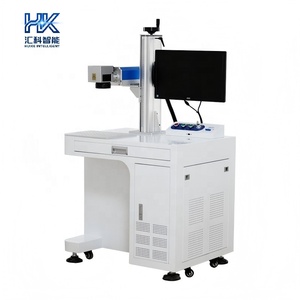
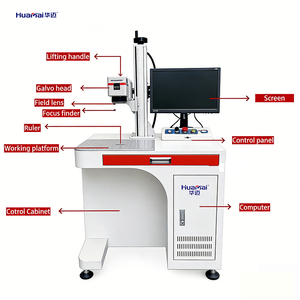
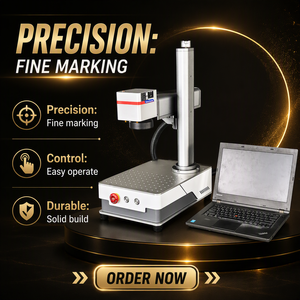
Understanding beam dynamics, Master Oscillator Power Amplifier (MOPA) topology, Q-switching mechanics, and European safety compliance standards for industrial OEM integration.
Industrial laser processing has undergone a paradigm shift from conventional lamp-pumped and CO2 gas systems toward solid-state ytterbium-doped fiber laser sources and cold-processing 355nm UV sources. As a direct OEM factory and international exporter, our manufacturing pipeline prioritizes fundamental photon physics, ensuring that beam parameter product (BPP), M² beam quality factor, and wall-plug efficiency meet stringently audited European CE standards (EN 60825-1:2014, 2006/42/EC Machinery Directive, and 2014/30/EU EMC Directive).
The core efficiency of a fiber laser source lies in its gain medium: a double-clad optical fiber doped with Ytterbium (Yb3+) ions, pumped by high-brightness semiconductor laser diodes operating at 915nm or 976nm. When evaluated by global procurement teams, the critical metrics extend beyond peak wattage to encompass pulse energy stability, Rayleigh length consistency, thermal lensing resistance, and total mean time between failures (MTBF).
MOPA (Master Oscillator Power Amplifier) sources allow independent tuning of pulse duration (2ns to 500ns) and repetition rate (1kHz to 4000kHz). Unlike standard Q-switched lasers where pulse duration is fixed by peak power, MOPA lasers eliminate micro-melting and heat-affected zones (HAZ) on sensitive polymers while enabling vivid black annealing on titanium and color marking on stainless steel.
Third-harmonic generation (THG) converts 1064nm fundamental wavelengths into 355nm ultraviolet output. Operating via photochemical reaction ("cold processing") rather than thermal ablation, UV lasers sever molecular bonds directly without thermal deformation. This is vital for thin-walled cosmetic packaging, HDPE pharmaceutical bottles, glass scribing, and PCB micro-drilling.
CE certification for export laser sources mandates comprehensive electrical safety, electromagnetic compatibility, and dual-channel optical interlocks. All factory-certified laser engines incorporate safety shutter monitoring, beam-dump attenuation, real-time reflection monitoring to protect diodes from back-reflections during copper cutting, and IP54 sealed optical housings.
Engineering specification parameters for procurement evaluation and material suitability.
| Laser Architecture | Wavelength | Pulse Width Range | M² Factor | Primary Target Substrates | CE Safety Classification |
|---|---|---|---|---|---|
| Standard Fiber (Raycus/MAX) | 1064 nm | 90 ns - 120 ns (Fixed) | < 1.5 | Carbon Steel, Stainless, Brass, Hard Plastics | Class 4 (Engine) / Class 2 (Enclosed) |
| MOPA Fiber (JPT M7 / MOPA) | 1064 nm | 2 ns - 500 ns (Tunable) | < 1.3 | Anodized Al, Stainless Color, PE, ABS, Foils | Class 4 (Engine) / Class 2 (Enclosed) |
| Cold Light UV (355nm) | 355 nm | < 15 ns | < 1.2 | Glass, Quartz, Silicon, Medical Plastics, Cosmetics | Class 3B / Class 4 Component |
| Super-Pulsed CO2 Source | 10.6 µm | Continuous / CW Pulsed | < 1.1 | Acrylic, Wood, Leather, Organic Textiles, Glass | Class 4 Component (EN 60825-1) |
Integrating legacy machine-builder precision (proven since 1982) with high-volume, cost-effective manufacturing for international OEM exporters.
Unlike trading intermediaries, our factory welds, machines, wires, and optically aligns every laser gantry under ISO 9001 certified protocols. By utilizing standard industrial components, documented wiring schematics, and rigorous 72-hour burn-in stress testing, we ensure that exported units arrive ready for immediate deployment on factory floors without recalibration delay.
We stand behind our super-pulsed CO2 laser sources and high-stability fiber engines with an industry-leading 3-year factory warranty. Supported by remote desktop diagnostics, worldwide component logistics, and factory-trained laser engineers, our service structure ensures minimal operational downtime and predictable total cost of ownership (TCO).
Analysis of upcoming technological shifts, automation protocols, and global supply chain imperatives shaping the 2026-2030 laser acquisition landscape.
The industry is rapidly migrating away from bulky water-chilled systems toward air-cooled 100W, 200W, and 300W high-power MOPA fiber laser engines. Breakthroughs in micro-channel heat pipe design and high-efficiency pump diodes now allow 300W pulse output in compact desktop form factors, cutting facility power consumption by up to 45% while preserving mobility.
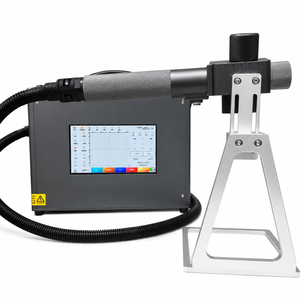
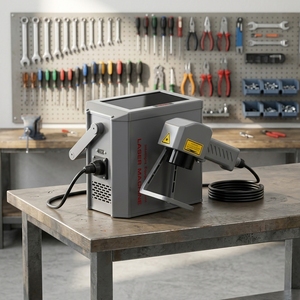
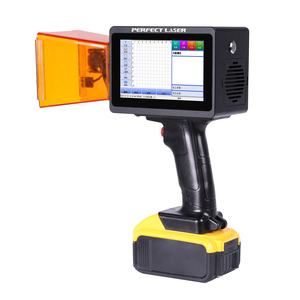
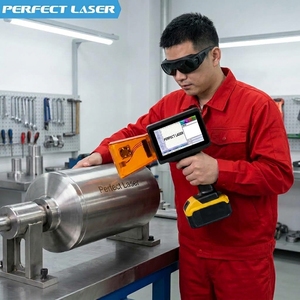
In-field identification, aerospace traceability, and heavy machinery inventory management require trace marking outside traditional machine enclosures. Ultra-portable handheld laser coders equipped with lithium-ion power packs and tactile auto-focus sensors represent the fastest-growing export category for infrastructure, pipeline, and structural metal manufacturing.
Industry 4.0 integration demands that laser sources act as connected smart nodes. Modern CE-certified laser controllers native-support Ethernet/IP, Modbus, and OPC UA protocols, broadcasting real-time laser diode temperature, back-reflection alerts, lens contamination metrics, and pulse count logging directly to Enterprise Resource Planning (ERP) systems.
Addressing critical technical, regulatory, and logistics queries for international sourcing managers.
Every exported laser system includes an official CE Declaration of Conformity detailing adherence to EN 60825-1:2014 (Laser Product Safety), 2006/42/EC (Machinery Directive), and 2014/30/EU (EMC Directive). Additionally, systems destined for the United States are registered with FDA CDRH (Center for Devices and Radiological Health) and supplied with official Accession Numbers for seamless customs clearance.
Standard fiber sources (Raycus, MAX) feature fixed pulse widths (~100ns) and are optimal for high-speed metal deep engraving, cutting thin sheet metals, and general coding on dark plastics. JPT MOPA sources offer adjustable pulse durations (2ns to 500ns), making them indispensable for color marking on stainless steel, high-contrast black marking on anodized aluminum, and delicate marking on heat-sensitive plastics like ABS, PC, and silicone without burning.
Factory-grade solid-state fiber laser diodes possess an MTBF (Mean Time Between Failures) exceeding 100,000 operational hours, equivalent to over 10 years of continuous single-shift operation. Because fiber lasers utilize solid-state gain media without gas refills or optical mirror alignment, maintenance is virtually non-existent—requiring only periodic cleaning of the external protective window on the F-Theta field lens and dust filter replacement.
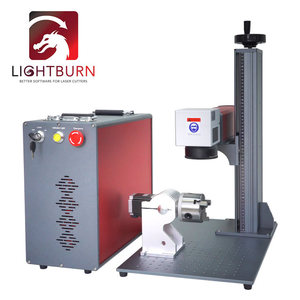
Yes. Handheld laser markers utilize localized focal positioning guides or auto-focus distance sensors. For cylindrical items such as pipes, shafts, or tools, systems can be fitted with 80mm or 100mm rotary axes or dual red-light focus pointers that allow operators to instantly establish precise focal distance on curved geometry prior to firing.
For standard marking and deep engraving, no external assist gas is required; an inline fume extractor with HEPA and activated carbon filtration is sufficient to capture dust and vaporized particulate. For heavy-duty metal cutting or high-wattage deep engraving (100W-300W), clean compressed air, Nitrogen (N2 for oxide-free bright edges), or Oxygen (O2 for speed on mild steel) is recommended.
All machinery exported globally is packaged in export-standard ISPM-15 compliant fumigation-free wooden crates. Optical galvo heads, laser sources, and power supplies are isolated with high-density anti-vibration EPE foam, vacuum-sealed in moisture-barrier aluminum foil bags with desiccant packs, and mechanically bolted to the pallet frame to withstand maritime and air transport shocks.
Speak directly with our factory application engineers. Send us your sample material specifications, vector files, or OEM requirements for free cut-sample processing, beam parameter analysis, and factory-direct export pricing.