0%

Choosing the right OptiDual Multi-Head Laser Machine requires more than comparing wattage, price, or advertising claims. Buyers must examine production goals, material types, cutting accuracy, software control, service access, and workplace layout. A machine may look impressive on a specification sheet, yet perform poorly when operators change materials throughout the day.

Dr. Elena Marlow, an independent laser-process consultant, says, “A dual-head system earns its value only when both heads improve real production flow, not merely machine capacity.” Her observation is practical. Two laser heads can reduce idle time, support parallel work, and improve scheduling. However, they can also increase maintenance demands, alignment checks, training needs, and energy consumption. More is not always better.

This Top OptiDual Multi-Head Laser Machine Buyers Guide examines the details that often receive less attention. It considers head synchronization, bed size, motion stability, laser source quality, extraction performance, control systems, and manufacturer support. It also addresses operator experience. A technically advanced machine still needs clear controls, safe access, and reliable daily procedures.

Measure the workflow first.

Readers will find guidance for comparing suppliers, requesting meaningful demonstrations, and calculating long-term ownership costs. Some recommendations may seem obvious, but real purchasing decisions are rarely perfect. Floor space can be underestimated. Material waste can be overlooked. Service response times may sound reassuring until production stops.

A careful buyer should challenge every promise and request evidence. The best OptiDual Multi-Head Laser Machine is not necessarily the fastest model. It is the system that delivers repeatable results, manageable upkeep, and measurable value within a specific operation.
Top OptiDual Multi Head Laser Machine Buyers Guide

What Is an OptiDual Multi Head Laser Machine?

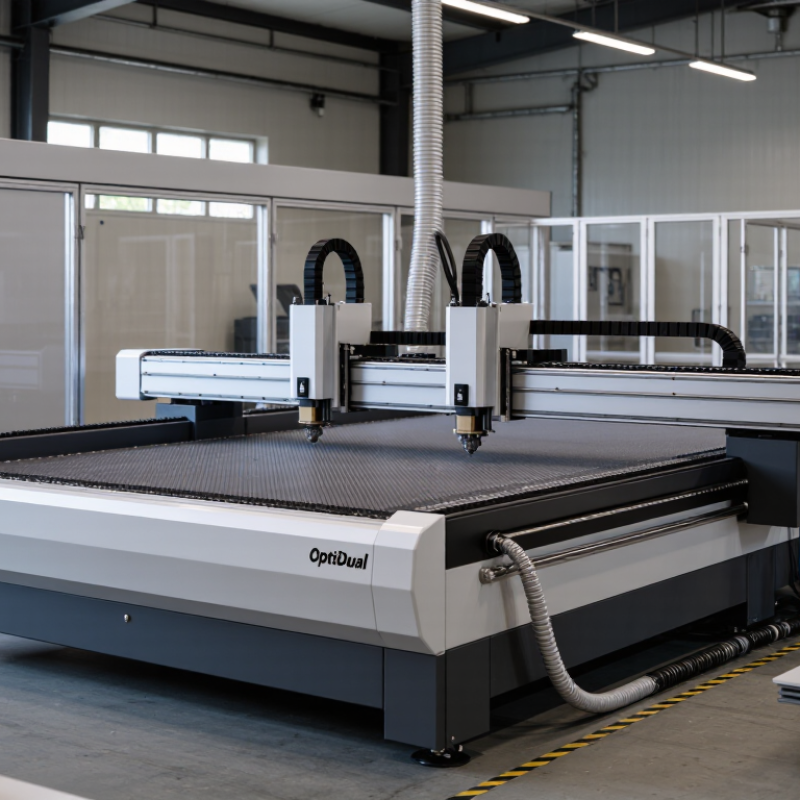
An OptiDual Multi Head Laser Machine is a cutting system with two laser heads working on one production platform. Each head follows a programmed path, either independently or in coordination. This design can process two separate parts, repeat the same pattern, or divide a large sheet into working zones.

The machine’s value is practical. Two heads may increase output without doubling floor space. However, performance depends on laser power, head alignment, motion control, extraction, and software settings. A 2024 market assessment by Fortune Business Insights valued the global laser cutting machine market at about USD 5.18 billion in 2023. It projects the market to reach roughly USD 9.32 billion by 2032. These figures show growing demand, but they do not guarantee better results from every dual-head system.

Watch the kerf.

In real production, two heads can also create problems. Poor calibration may produce slightly different edge widths or uneven corners. Heat can build near closely spaced cuts, especially on thin metal sheets. Operators should inspect test grids, measure repeatability, and compare cycle times with a single-head setup. A 2023 report from MarketsandMarkets identified automation and higher processing productivity as major market drivers. Still, productivity is not only head count. Material nesting, maintenance access, fume extraction, and operator training matter just as much. The “dual” advantage can be overstated when software is difficult to configure or downtime rises. A buyer should request sample cuts, documented accuracy data, and service response terms before choosing a machine.

How OptiDual Multi Head Laser Technology Works

How OptiDual Multi Head Laser Technology Works

Multi-head laser systems use two cutting heads on one machine platform. Each head receives a focused beam through its own optical path. The control system assigns separate zones or synchronized patterns. This can reduce idle movement and improve sheet utilization. However, both heads cannot always cut every geometry at maximum speed.

The real advantage appears in repeated production. One head may process the left section while the other handles the right section. Sensors monitor height, focus, and material position during cutting. Assist gas then removes molten metal from the kerf. Accurate control matters because heat can distort thin sheets. A 2024 Grand View Research analysis estimates the laser cutting machine market will expand at about 6% annually through 2030. That growth reflects demand for faster, automated fabrication, not speed alone.

Tips: Compare independent-axis control, autofocus response, gas-pressure stability, and nesting software. Request test cuts using your actual thickness and alloy. Measure cycle time, edge roughness, scrap, and nozzle wear. The fastest brochure figure may fail on dense layouts. In practical trials, small alignment errors can create visible taper between two heads. That detail is easy to miss. ISO 9013 edge-quality classes can provide a more reliable comparison than marketing claims. A buyer should also check service records, calibration routines, and operator training. Dual heads increase output potential, but they also increase setup complexity.

Top OptiDual Multi Head Laser Machine Buyers Guide

How Multi-Head Laser Technology Works

The chart shows the theoretical cutting-capacity multiplier as additional laser heads work in parallel. One active head represents 1× capacity; two synchronized heads can reach up to 2× capacity when they process separate parts with similar cutting requirements. Actual productivity depends on material thickness, cutting path, loading time, head positioning, piercing cycles, and machine utilization.

Key Features to Compare Before Buying

Top OptiDual Multi Head Laser Machine Buyers Guide

When comparing a multi-head laser machine, examine the real working area first. Two heads do not always double production. Their spacing, alignment, and independent control affect practical output. Ask for cutting tests using your actual materials and thicknesses. Check edge quality, kerf width, engraving detail, and heat marks. A fast machine may still waste time during setup.

Tips: Request a live demonstration. Measure noise, fumes, and access space. Confirm whether both heads can work together or separately. Review the cooling system, motion rails, emergency stop, and enclosure design. Reliable safety features matter more than impressive speed claims. Also inspect software controls. Clear settings reduce operator mistakes, especially during repeated jobs.

Power stability deserves close attention. Inconsistent output can create uneven cuts across one sheet. Ask how the machine maintains calibration over long production hours. Examine maintenance access, replacement part availability, training, and response times from technical support. These details often decide whether downtime lasts minutes or days. I would not trust a brochure alone. My own comparison would include a timed trial, although one trial cannot predict every material. Leave room for that uncertainty. Be cautious with machines that hide power ratings or provide vague accuracy figures. A dependable purchase should include written specifications, test results, and realistic operating costs.

Top OptiDual Multi Head Laser Machine Buyers Guide - Key Features to Compare Before Buying

A practical comparison framework for evaluating multi-head laser machines according to production needs, material requirements, safety, operating cost, and after-sales support.

Comparison Dimension What to Compare Typical Buyer Requirement Why It Matters Recommended Verification
Laser Type CO₂, fiber, or hybrid laser source CO₂ for many non-metal materials; fiber for reflective and sheet-metal applications The laser source determines material compatibility, cutting behavior, maintenance needs, and overall application range. Confirm the source type, rated wavelength, intended materials, warranty coverage, and replacement cost.
Laser Power Rated output in watts Choose power based on material type, thickness, cutting speed, and required edge quality Higher power can improve productivity on suitable materials, but it may increase purchase price, energy use, and ventilation requirements. Request verified cutting samples at the exact thickness and speed required for production.
Number of Heads Single, dual, or multiple synchronized heads Dual-head operation for repeated parts, paired layouts, or higher throughput Multiple heads can reduce cycle time when the workpieces, patterns, and spacing are suitable for parallel processing. Check whether all heads can operate simultaneously and whether each head has independent height control.
Working Area Usable length, width, and material clearance The bed should exceed the largest routinely processed sheet or workpiece A properly sized work area reduces repositioning, improves nesting efficiency, and lowers the risk of damaging oversized materials. Measure the actual usable area, not only the external machine dimensions.
Positioning Accuracy Declared positioning and repeatability specifications Accuracy suitable for the tolerance of the finished product Accurate motion improves part consistency, assembly fit, engraving alignment, and repeat production quality. Ask for test results, measurement conditions, calibration procedures, and repeatability data.
Motion System Guide rails, drive mechanism, motors, and gantry structure Rigid construction with smooth motion and accessible maintenance points Mechanical rigidity affects cutting quality, vibration, service life, and performance at higher acceleration. Inspect rail protection, drive components, lubrication requirements, and maximum acceleration settings.
Automatic Focusing Manual, semi-automatic, or automatic focus adjustment Automatic focusing for mixed materials or frequent thickness changes Correct focal distance supports consistent kerf width, edge quality, and cutting performance. Verify focus response time, supported thickness range, calibration method, and sensor protection.
Control System Operator interface, file compatibility, nesting, and job management Intuitive controls with common vector-file support and reliable job recovery Software usability influences training time, setup errors, material utilization, and daily productivity. Test importing typical design files, editing parameters, previewing the tool path, and restarting interrupted jobs.
Material Compatibility Supported plastics, wood, textiles, composites, metals, or other materials Compatibility must match the buyer’s approved material list Some materials can release hazardous fumes, melt unexpectedly, reflect laser energy, or require specialized settings. Obtain a written material compatibility list and follow relevant safety data sheet requirements.
Exhaust and Filtration Extraction capacity, ducting, filtration, and airflow design Extraction sized for the machine enclosure and materials being processed Effective extraction protects operators, reduces residue, improves visibility, and helps prevent contamination of optical components. Confirm airflow specifications, filter stages, replacement intervals, duct requirements, and local installation rules.
Safety Features Enclosure, interlocks, emergency stops, warning systems, and access controls Fully enclosed operation with functional interlocks and emergency shutdown Laser processing involves optical, thermal, electrical, fire, and fume hazards that require engineered safeguards. Inspect safety circuits, access-door interlocks, fire-prevention provisions, and applicable regional compliance documentation.
Cooling System Air cooling or liquid chiller capacity and monitoring Cooling capacity matched to laser output, ambient temperature, and operating schedule Stable temperature control helps protect the laser source and maintain consistent output during extended production. Check cooling capacity, temperature alarms, coolant requirements, maintenance schedule, and operating temperature limits.
Automation Potential Automatic loading, unloading, conveyors, rotary attachments, or material handling Automation for high-volume, repetitive, or labor-intensive production Automation can reduce manual handling, improve consistency, and increase machine utilization. Calculate expected labor savings and confirm that automation works with the intended material dimensions and weights.
Power and Installation Electrical supply, floor space, ventilation, compressed air, and access requirements Installation conditions must match the facility before delivery Unexpected utility upgrades or insufficient floor access can delay commissioning and increase project cost. Request a complete installation checklist covering voltage, current, grounding, airflow, clearance, and machine weight.
Operating Cost Energy, assist gas, lenses, nozzles, filters, coolant, and labor Evaluate total cost per operating hour rather than purchase price alone Consumables and downtime can significantly affect the long-term cost of ownership. Build a 3–5 year cost model using expected operating hours, consumable prices, maintenance, and energy rates.
Maintenance Access Access to optics, filters, rails, belts, sensors, and electrical components Routine service should be safe, clearly documented, and reasonably quick Easy maintenance reduces downtime and helps preserve cutting quality and machine accuracy. Review maintenance intervals, cleaning procedures, spare-part availability, and technician access requirements.
Training and Support Installation, operator training, troubleshooting, remote assistance, and documentation Structured commissioning and accessible technical support Good support shortens the learning curve and helps resolve setup or process issues before they affect production. Confirm training duration, response times, language options, manuals, video resources, and escalation procedures.
Warranty and Spare Parts Warranty scope, exclusions, service coverage, and component lead times Clear written terms for major components and consumable parts Warranty clarity reduces financial risk and helps buyers plan for service interruptions. Check coverage for the laser source, motion system, controller, chiller, optics, labor, shipping, and replacement parts.
Productivity Validation Cycle time, material yield, edge quality, repeatability, and uptime Performance should be demonstrated using the buyer’s actual production files Marketing specifications may not reflect real output under the buyer’s material, design, and quality conditions.
Purchase Decision Performance, safety, service, integration, and total ownership cost Select the configuration that meets production requirements with a practical risk profile The lowest initial price may not provide the best value if productivity, support, safety, or reliability is insufficient.
Buyer’s note: Actual performance depends on material composition, thickness, design complexity, laser settings, operator skill, environmental conditions, and machine configuration. Always validate the machine with production-representative samples before making a final purchase decision.

How to Choose the Right Machine for Your Production Needs

Choosing a multi-head laser machine starts with your production facts, not the highest advertised power.

Record material type, thickness, sheet size, daily volume, and required tolerance. A machine cutting thin steel all day needs different optics from one processing thick aluminum. According to the International Federation of Robotics’ World Robotics 2024 report, 541,302 industrial robots were installed globally in 2023. This signals rising automation, but automation only pays when workflow matches capacity.

Review the complete process.

Multi-head systems can increase output, yet they may require wider beds, stronger extraction, and more careful material handling. Ask suppliers for test cuts using your actual material. Measure edge quality, piercing time, heat distortion, kerf consistency, and changeover minutes. The International Organization for Standardization’s ISO 230-2 framework also highlights machine positioning accuracy and repeatability as measurable performance factors. Do not accept vague claims.

Calculate cost per finished part, not purchase price alone.

Include laser source life, assist gas, lenses, electricity, maintenance, software, and operator training. The U.S. Department of Energy reports that motors and driven equipment can represent a major share of industrial electricity use, making efficient motion systems worth examining. Still, efficiency figures can be difficult to compare across test conditions. I would challenge every number. A cheaper machine may become expensive when idle time, alignment errors, or unsupported software interrupt production. Leave room for mistakes. Real workshops rarely run like brochures.

Operating Costs, Maintenance, and Buyer Considerations

A multi-head laser machine can raise output, but its operating cost is more than the purchase price. Electricity, assist gas, lenses, nozzles, filters, and labor all affect the monthly budget. Record actual power use during a typical shift. Short test runs can hide idle time and setup losses. Those details matter.

Maintenance begins with cleanliness. Dust on protective windows can distort the beam and increase scrap. Operators should inspect lenses, cooling lines, extraction filters, and motion components on a fixed schedule. Keep spare consumables nearby. A missing nozzle can stop production for hours. Service records should include dates, replaced parts, symptoms, and corrective actions. This creates useful evidence when costs suddenly rise.

Buyers should compare cutting speed under real material thicknesses, not only brochure figures. Ask for sample tests using your own metals, tolerances, and daily workload. Check whether one head can keep operating while another receives service. That redundancy may protect production, but it can also increase calibration demands. Training quality matters as much as machine specifications. I have seen buyers focus on capacity and underestimate operator learning time. That was a costly assumption. A rough return-on-investment estimate should include scrap, downtime, ventilation, software updates, and preventive service. Cheap maintenance is not always reliable maintenance.

FAQS

What is a dual-head laser cutting machine?

It is a cutting system with two laser heads on one production platform. Each head can follow separate paths or shared patterns. This may increase output without doubling floor space.

Can two laser heads always cut twice as fast?

No. Output depends on alignment, power, software, nesting, and material thickness. Closely spaced cuts can also create heat buildup. More heads do not guarantee double productivity.

How can dual heads improve production?

One head can cut the left section while the other processes the right. Both heads can also repeat identical patterns. This reduces idle movement during suitable production runs.

What problems can poor calibration cause?

Poor calibration may create different kerf widths, uneven corners, or tapered edges. Small alignment errors can become visible on a test grid. The defect may look minor, but it affects fit.

Which materials and tests should buyers evaluate?

Buyers should test their actual alloys, thicknesses, and typical layouts. Measure cycle time, edge roughness, scrap, heat marks, and nozzle wear. A showroom sample is not enough.

What machine features deserve close comparison?

Compare working area, independent-axis control, autofocus response, gas-pressure stability, and nesting software. Check cooling, motion rails, enclosure design, and emergency controls. Access space matters too.

How important are software and operator training?

They are highly important. Clear controls can reduce setup mistakes during repeated jobs. Poor software may erase the expected speed advantage. This is easy to underestimate.

What service information should buyers request?

Request written accuracy data, calibration routines, maintenance access, training details, and response times. Check replacement-part availability and realistic operating costs. I would not trust a brochure alone.

How can buyers confirm real performance?

Request a live demonstration with timed test cuts. Compare the results with a single-head setup. Inspect edges, heat marks, scrap, and repeatability. One trial cannot predict every material.

Conclusion

An OptiDual Multi-Head Laser Machine is a production system designed to improve cutting, engraving, or marking efficiency by using two or more coordinated laser heads. Its dual-head configuration can process multiple areas, repeat identical patterns, or handle different tasks with less repositioning. This guide explains how the technology works, including beam control, motion synchronization, focusing, and material handling, so buyers can understand how machine design affects accuracy, speed, and consistency.

Before purchasing, compare laser power, working area, head spacing, positioning precision, software compatibility, safety features, cooling systems, and supported materials. The right model should match your production volume, product size, design complexity, and required tolerances rather than simply offering the highest specifications. Buyers should also evaluate operating costs, energy use, ventilation, consumables, preventive maintenance, replacement parts, training, and technical support. A careful assessment of total ownership cost will help ensure reliable performance, efficient workflows, and long-term value.

Ethan

Ethan

Ethan is a dedicated marketing professional with a strong understanding of the company’s products, services, and market environment. With a background in strategic communication, customer research, and content development, he transforms complex product information into clear, practical, and......