Pipe and Tube Rotary Laser systems have moved from specialist equipment to practical tools for fabricators handling round, square, and rectangular profiles. They rotate the workpiece while a focused beam cuts slots, holes, and contours. In a busy shop, the difference shows up in small details: a clean saddle cut, a stable tube feed, and less hand-finishing at the bench.
The scale of the materials market is substantial. The World Steel Association reported 1,882.6 million tonnes of global crude steel production in 2024. That figure does not measure tube-laser sales, but it shows why efficient steel processing matters. For a grounded comparison, John Powell, a laser-processing author and specialist, emphasizes in his technical work the need to match laser settings to the material and cutting process. Put simply: power alone is not the whole story. Buyers should also examine rotary-axis accuracy, chuck design, software, service access, and demonstrated cutting results. A thicker brochure is not proof.
This guide reviews ten manufacturers through those practical lenses. It considers machine capability, production fit, and the support available after installation. Specifications still need verification against real parts; published claims may not capture every shop-floor constraint. That is worth remembering. A shortlist helps, but the right choice depends on the tubes, tolerances, workload, and budget a fabricator actually has.
What Rotary Tube Lasers Do: CNC Control, Chuck Rotation, and Cutting Axes
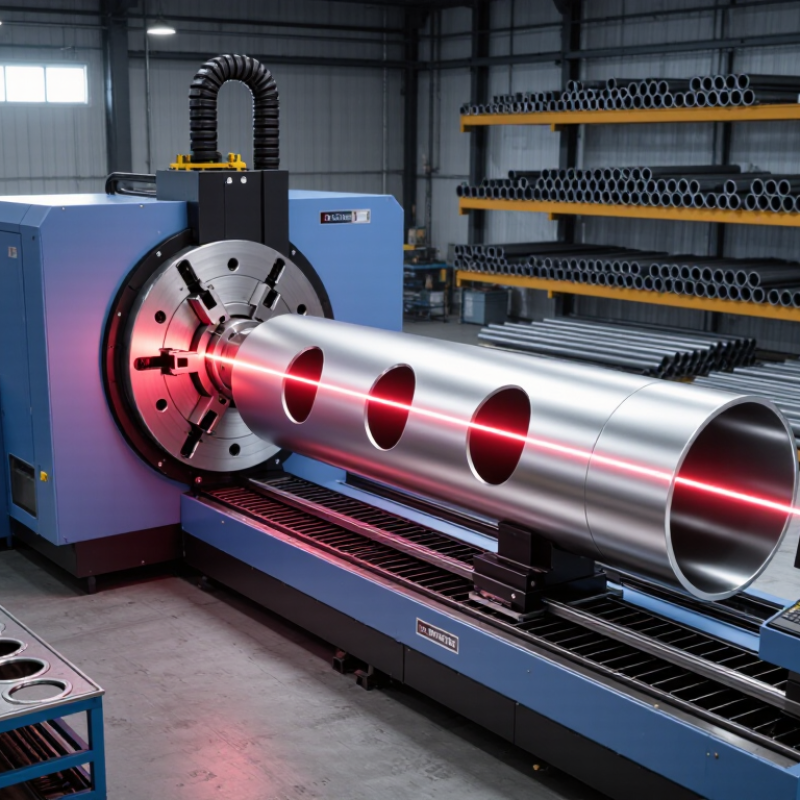
A rotary tube laser combines a focused beam with a CNC-controlled workpiece. The controller follows a programmed path while the chuck turns the tube beneath the cutting head. This setup can cut round, square, and rectangular profiles, provided the machine and tooling suit the material and dimensions. Small details matter. A tube that is slightly bowed may sit differently from a straight sample, affecting alignment and cut quality.
Chuck rotation is typically coordinated with the laser head’s movement along the tube. The machine may use a linear axis to travel down the workpiece and a rotary axis to present each face to the beam. Some systems also move the cutting head across or around the profile. The exact axis arrangement varies, so buyers should confirm what the machine can control—not just how many axes appear in a specification.
CNC programming sets the cut path, speed, and sequence, while sensors and setup procedures help keep the tube positioned. Operators still need to select suitable chuck pressure, supports, and cutting parameters. Too much pressure can mark thin walls; too little can allow movement. In practice, setup is not always tidy, especially with short offcuts or changing tube sizes. Test cuts and careful measurement help reveal problems before a full production run.
The table below is a practical guide to ten technical capabilities used to compare rotary tube laser systems. It is not a ranked list of manufacturers. Specifications vary by machine model and configuration; confirm the required capacity and functions with the supplier.
| No. | Capability | What It Does | Typical Design or Range | What to Check |
|---|---|---|---|---|
| 1 | CNC control | Reads the part program and coordinates tube movement, chuck rotation, laser output, and auxiliary functions. | Typically combines a machine controller, motion system, nesting or programming software, and operator interface. | Check supported file formats, post-processor availability, simulation, alarms, and program transfer workflow. |
| 2 | Chuck rotation (A axis) | Turns the tube around its longitudinal axis so the laser can cut different sides and orientations. | A rotary servo axis commonly works with a chuck that grips round, square, or rectangular stock. | Verify chuck opening, clamping range, repeatability, and whether rotation is continuous or indexed for the intended operation. |
| 3 | Linear motion axes | Move the cutting head and/or tube along the machine to position the beam at the programmed cut path. | Axis names and layouts differ; machines commonly use longitudinal and crosswise motion, with vertical head motion where fitted. | Ask for the axis diagram, travel limits, positioning accuracy, and explanation of how tube feed is handled. |
| 4 | Bevel or tilt axis | Tilts a compatible cutting head to produce angled edges or bevels. | An additional rotary axis may be available on bevel-cutting configurations; it is not standard on every tube laser. | Confirm tilt range, supported material and wall thickness, collision limits, and whether the software programs bevels. |
| 5 | Tube and profile capacity | Defines the stock shapes and sizes that can be loaded, clamped, rotated, and cut. | Capacity is model-specific and may cover round tube, square tube, rectangular tube, and selected open profiles. | Compare maximum and minimum dimensions, corner geometry, wall thickness, and profile support against actual production parts. |
| 6 | Automatic loading and feeding | Feeds raw stock into the cutting area and can reduce manual handling between cycles. | Automation may range from manual loading to bundled-stock loading with an automatic feed system. | Check bundle size, stock straightness requirements, loading time, and compatibility with the tube shapes being processed. |
| 7 | Chuck arrangement and remnant control | Supports the workpiece during rotation and feeding; some layouts move or coordinate multiple chucks to process more of the bar. | Single- and multi-chuck layouts are available, with usable cut length and remnant depending on machine design. | Request the stated minimum remnant under a defined test condition and confirm support for short parts. |
| 8 | Laser source and cutting head | The laser source supplies the beam, while the cutting head focuses it and delivers assist gas at the cut. | Fiber laser systems are commonly used for metal tube cutting; suitable power depends on material, thickness, and process requirements. | Check tested material and thickness, edge quality, assist-gas needs, consumable costs, and service arrangements. |
| 9 | Tube measurement and compensation | Can help account for tube position, rotation, or dimensional variation before or during cutting. | Available sensing and compensation functions vary; they may include locating features or detecting stock orientation. | Ask which sensors are included, what errors they compensate for, and how the function is demonstrated on sample parts. |
| 10 | Safety and extraction | Enclosures, interlocks, and fume extraction help manage laser radiation, moving parts, sparks, and cutting fumes. | Safety configuration depends on the machine design, installation, applicable regulations, and production environment. | Review the risk assessment, guarding, interlocks, extraction connection, and documentation for the destination market. |
Limits vary by model and chuck design. Check the stated minimum and maximum for each profile. It varies.
Not always within the same capacity range. Ask for a chart that lists each profile and its diameter or dimensions.
Material, laser power, speed, and assist gas all matter. Thin stainless tubing may cut quickly, while thick carbon steel may need slower settings.
No. Power alone does not determine output. Chuck rotation, piercing, acceleration, and loading can limit daily production.
Confirm the supported stock length and loading method. Long tubes can sag, so ask how the machine supports them during cutting.
No. Request written limits for diameter, wall thickness, profile, and length. A tidy chart can still leave gaps.
Use your actual material and wall thickness. Check burrs, heat marks, edge quality, and handling—not only cutting speed.
Time the same tube batch on each setup. Record loading time, finished parts, scrap, and rework per shift. One test may still miss daily variation.
This article explores what makes a Pipe and Tube Rotary Laser effective for modern pipe fabrication, from CNC control and chuck rotation to the cutting axes that shape round, square, and other profiles. It explains how supported tube diameters, wall thicknesses, and workpiece lengths affect machine selection, and how fiber laser power from 1 to 6 kW can influence cutting capacity, speed, and overall productivity.
The comparison framework also considers cut quality using ISO 9013 classes, while highlighting practical differences in chuck design, loading and unloading automation, and after-sales service. Together, these factors help readers assess Chinese manufacturers based on processing needs, production goals, and long-term operating requirements rather than relying on a single specification.